The Importance of Worldview
Worldview has to do with our beliefs about the nature of reality and the world, particularly in regard to the questions of our origin and destiny.
These foundational questions are philosophical and religious but our view of the answers to these questions impact almost everything else in our personal lives and in our culture.
The image of a Rooted Tree may be helpful.
Our worldview is like our roots. They are unseen but generally give stability in the storms of life. World view has to do with the questions of why we exist, the nature of God and God's purposes for our existence. Worldview therefore should not be chosen arbitrarily or without examination.
Usually a worldview is rooted in its story or "meta-narrative" which gives context to that worldview. I know there are competing meta-narratives, but let me share that of the Biblical worldview.
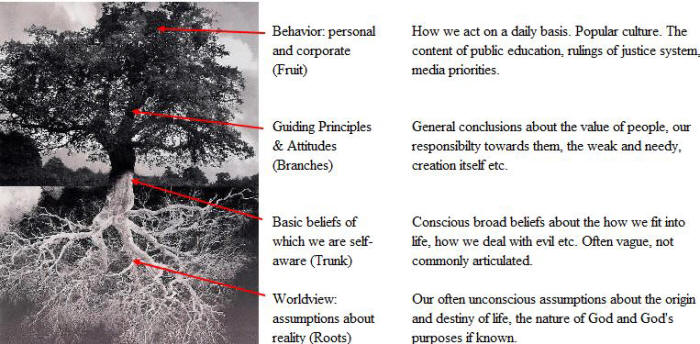
Out of our worldview flow our foundational beliefs. These may be compared to the trunk of the tree. The truck relates to our view of our purpose in life, how we respond to resistance to that purpose including the origin and overcoming of evil, and the nature of the highest good which can be achieved in our life.
Out of these foundational beliefs flow our guiding principles. These may be compared to the branches of the tree and be expressed in our character or basic attitudes towards the value of people, particularly also the poor and needy, those who oppose us, work and ethics, and creation itself.
Out of these guiding principles and attitudes flow our practical decisions, behaviours, words and actions. These outcomes may be illustrated by fruit of the tree. Fruit is what most people see and would say characterize us. But how we live our lives is in fact already largely determined by our worldview.
From the Roots of Worldview Flows Almost Everything
The foundations of worldview profoundly affect our personal lives as well as every institution of society - political parties, social policies, educational philosophies, views of philanthropy - nothing remains untouched. For this reason, and others, it is important to choose wisely.
At the risk of starkness, I think it's fair to suggest essential distinctions rooted in varying basic worldviews as follows:
|
|
Origins |
Foundational Beliefs |
Ethics: Principles & Attitudes |
Destiny |
| Animism |
The question of origins is
not addressed. There is no concept of a Creator, only good and
bad spirits whose favor must be bought, earned or manipulated.
|
Power or energy needed in life must be protected and may be stolen. Evil spirits must be appeased or used against others through rituals, sacrifices, or curses. Some have greater capacity to coerce the spirits to do their bidding (shamans, witch doctors) | There is a fixed amount of goods and energy. For one person to gain, another has to lose. If one wants to be less poor or more rich, one must take from others or through the spiritual world cause the transfer from one to another. Hexes and curses are for this purpose. | Human souls enter the spirit world at death where they will have influence over the physical world and are to be feared. |
|
Hindu |
Life is believed to be cyclic so the cycle of creation, preservation and destruction has no beginning. |
You receive what you deserve (Karma). Polytheistic. |
There is no point in expecting improvement of one's lot in life (fatalism) |
Repeated cycles of births and deaths. |
|
Jewish |
God created out of love and desire for covenant relationship with humankind and creation. |
Creation is good though God's purposes are resisted (i.e. existence of evil). The Messiah will come. |
Obedience to the Law is the best practice until the Messiah comes. |
The Messiah will redeem the earth, the believing soul will be purged of its blemishes. |
|
Christian |
God created out of love and desire for covenant relationship with humankind and creation. |
Creation is good and life is valuable. God's purposes however are often resisted (i.e. existence of evil). God nevertheless redeems sinners through the Cross of Christ. |
Highest good is to become Christlike in character. Christ's followers love and sacrifice for good, the weak and those wounded by evil. |
Those following Christ become like Him in eternity. Those rejecting Him experience a Christless eternity without God. |
|
Secular/Atheist |
Time and chance produced what is without purpose or meaning. |
Survival of the fittest. No reason to have compassion on the weak. |
Enjoy life while it lasts. If meaning is desired, you must produce it. |
Non-existence |
|
Buddhism |
Life is viewed cyclic so the question is generally ignored. Buddha uses the current world cycle however to explain the caste system. |
A philosophy of harmony with the world and others is promoted. The question of God is not developed; technically atheistic. |
Ethics flow from the many of the sayings and observations of Buddha. |
Ultimate harmony with through absorption into the whole resulting in non-existence. |
|
Muslim |
Not expressed in unified fashion but similar in some ways to Judaism and Christianity. |
God is great but distant and not knowable in personal relationship. |
Diligent observance of prayers, pilgrimage and other behaviours seek God's favour. |
God will judge, but whether one's destiny is heaven or hell remains unknown. |
While some will take issue with parts of this summary I believe it to be essentially accurate in direction and demonstrable in history. For two reasons I ask you to consider and embrace the worldview of Jesus Christ and those who follow him.
-
Because we inexorably tend towards what (or who) we worship (i.e. hold highest).
-
Because eternal destiny, while not often considered in youth, is to be taken with at least as much seriousness as life itself.
The Foundation of an Accurate Worldview
The word "worldview" flows popularly from the German concept of "Weltanschauung." This question of perspective on the world has an important limitation which must be addressed.
While it's true anything (e.g. a mountain or elephant) can look different from various perspectives, it is not true that the various perspectives change an elephant from being an elephant or change a mountain from being a mountain.
The most important question about reality then is - "what is it?" - rather then then the narrower "what does it look like to you from your current angle of limited human experience?"
"What is it?" is in fact revealed in scripture and demonstrated by Christ.
Reality in its entirety is created by the Triune God (the time and means of creation is interesting but decidedly secondary) and shaped in battle by Lucifer and his followers against those loyal to their creator. All things and beings are not equal and the hierarchy looks essentially like this:
Father, Christ Incarnate and Holy Spirit (Creator and Redeemer)
Michael and Lucifer (archangels with, or in the case of Lucifer (aka Satan), against God) Angels and demons (working the will of God or Lucifer) Humans (victims, the oblivious and saints)
Some wonder why Christians are confident enough in Christ to die, if need be. We acknowledge this confidence is not unique to Christians but the reason for our faith is important and is here.
What then is culture? The word comes from its root "cult" - the core beliefs of a people; a reflection of what people most deeply believe about ultimate reality and the most profound questions of life. In other words, culture is the practical expression or application of the worldview of a group of people. Worldview matters.
Impact of Christian Worldview on Culture: For example the worldview of Christians resulted in distinctly positive cultural values and practices within decades of Christ. Explore the effects of the Christian worldview in history and the reality that this social impact cannot be generated by law or government, but is rooted in vital relationship with Christ.
If you've not already done so, please read a brief overview of the Biblical meta-narrative giving rise to the Christian worldview. If you think the question of whether the universe came into being by an external agency, outside of itself (i.e. was created), or has always existed, is of mere theoretical interest, you may be stimulated by RJ Rushdoony, The Religion of Revolution. One's worldview of origins has remarkable implications: here.
May you see the importance of worldview before coming to the conclusion flowing out of the worldview of Lu T'ung: "I am not interested in immortality, only the taste of tea."
The Impact of Worldview on Politics: One impact of worldview is expressed in value clusters which affect political views and goals. While the political spectrum is often viewed as a left/right dichotomy, worldview is more complex and my sense of this nuance is reflected in the following political categories flowing out of one's worldview:
I'm still in process thinking this through but would offer this further detail of political value clusters flowing out of worldview:Far Left/Marxist - Willing to consider use of violence to achieve ends or condone or depend those who do.
Left/Progressive - urgent for change, not really able to give serious consideration to other views and generally not able or willing to accept the people who hold them. Unwilling to use violence to achieve ends.
Classic Liberal - broad minded and generally open to change, even eager to move forward. Able and willing to listen, dialogue and accept people of other categories even if not accepting all their views.
Classic Conservative - recognizes that change is constant but wants to preserve/conserve the best of the past rather than assuming everything will or most change. Able and willing to listen, dialogue and accept people of other categories even if not accepting all their views.
Right - wants to go back to a place in history that no longer exists and are generally not good listeners and not generally able to accept people of other categories or their views. Unwilling to use violence to achieve goals.
Far-Right - want to go back in history and willing to consider use of violence to achieve goals or condone or depend those who do.
|
Political Orientation |
Ultimate Reality |
Relation to Monotheist Religion |
Value of the Individual |
Freedom of the Individual |
|
Marxist |
No belief in afterlife or accountability to God |
No influence by religious values |
Low to no value of human life/rights. (State is infinitely precious.) |
No freedom of speech, thought, assembly and religion. |
|
Progressive |
Low belief in afterlife and accountability to God |
Very low influence by religious values |
Moderate value of human life/rights |
Limited freedom of speech, thought, assembly and religion. |
|
Liberal |
Moderate-to-low belief in afterlife and accountability to God |
Low influence by religious values |
Moderate value of human life/rights |
High value to freedom of speech, thought, assembly and religion. |
|
Conservative |
High belief in afterlife and accountability to God |
Highly influenced by religious values |
High value of human life/rights |
High value to freedom of speech, thought, assembly and religion. |
|
Right |
High belief in afterlife and accountability to God |
Highly influenced by religious values |
High value of human life/rights |
High value to freedom of speech, thought, assembly and religion. |
|
Far Right |
High belief in afterlife and accountability to God |
Highly influenced by religious values |
High value of human life/rights. (Individual infinitely precious.) |
High value to freedom of speech, thought, assembly and religion. |
|
Political Orientation |
Size/Power of Government |
Role of Constitution, Rule of Law and Judiciary |
Ultimate Responsibility for the individual |
Core Intention (sometimes unstated) |
|
Marxist |
Unlimited government (the bigger the government, the smaller the citizen) |
Rule by party fiat. Party leader changes constitution at will. Judiciary serves |
Individual exists to serve the state |
I'm going into a different future and will take you with me. |
|
Progressive |
High government control. |
Constitution viewed as ‘living’ (changing) document. Primarily rule of judiciary. |
Society serves the individuals society values. |
I'm going into a different future and you are coming too. |
|
Liberal |
Large role for government. |
|
Society primarily responsible for care of individuals. |
I'd like to see change for the better |
|
Conservative |
Small role for government. |
Judiciary supports constitution. Rule of law. |
Nuclear family primarily responsible for care of individuals. |
As society changes, I’d like not to lose the best of the past |
|
Right |
Very small government control. |
Judiciary supports constitution. Rule of law. |
Nuclear family primarily responsible for care of individuals. |
I very much want change back to traditional values and practices. |
|
Far Right |
Highly limited government role. (the larger the citizen, the smaller the government) |
Constitutional government, Judiciary ensures constitution is upheld. |
Individual primarily responsible for care of self |
I'm going to take as many of us as possible back to traditional values and practices. |
 Murray Moerman (