|
The Problem of Evil in God's Universe
|
|
Though evil threatens and sometimes appears to hold an upper hand for a season, God allows evil no permanent victory. Even in it's temporary position "God allows evil only so as to make something better result from it." (Thomas Aquinas).
"The decisive question is therefore not, "How can anyone believe in a good God when there is so much evil.?" but rather, "how could a person with a heart and understanding endure life in this world if God did not exist?"1
First, let's address two related issues: fatalism and dualism. Neither is a biblical concept.
Fatalism is the view that everything in history is scripted and happens regardless of human efforts to determine their own lives. I often hear people say, "Well, I guess it was meant to be." Christians who say this are often influenced by a misunderstanding of predestination; the fact God has chosen and will safely guide those under His grace to the safe-haven of eternal life in "a new heaven and earth" (2 Peter 2). Predestination is this promise of victory, not a mechanical fatalism. Fatalism is an ancient Greek philosophical concept, not a biblical one. Humans have a free will and our choices affect history, both for good and evil.
Dualism is the view that good and evil exist as equal, but polar opposites, balancing (as in Eastern religions) or opposing (as in Western philosophy) each other. The question is whether God/good will win in the end. Dualism is also rooted in Greek philosophy rather than a Biblical worldview. Dualism leads to hopelessness, whereas in the cross and resurrection of Jesus evil is given it's fatal blow and death is defeated. In the resurrection, God has proven he is greater than Satan, and his Kingdom of righteousness will overcome Satan's kingdom of injustice and evil.
How then do we understand evil?
Most importantly Jesus makes it clear that evil is not God's will, and that evil exists in spite of and in opposition to God's will. Implicit in Jesus' prayer "Thy will be done on earth as it is in heaven," is the truth that God's will is not being done on earth and that God wants His will to be done on earth.
How then can Evil Exist Against God's Will? There are at least three factors in the existence of evil and suffering:
1. Free Will: God has chosen to give humanity a free will. Free will means we are not robots but have the God-given ability to do good or evil. C.S. Lewis puts it succinctly:
"God created things which had free will. That means creatures which can go either wrong or right. Some people think they can imagine a creature which was free but had no possibility of going wrong; I cannot. If a thing is free to be good it is also free to be bad. And free will is what has made evil possible. Why, then, did God give them free will? Because free will though it makes evil possible, is also the only thing that makes possible any love or goodness or joy worth having. A world of automata - of creatures that worked like machines - would hardly be worth creating. The happiness which God designs for His higher creatures is the happiness of being freely, voluntarily united to Him and to each other in an ecstasy of love and delight compared with which the most rapturous love between a man and a woman on this earth is mere milk and water. And for that they must be free.
2. Consequences: God has chosen to design the universe also in such a way that actions have consequences. Science calls this "cause and effect." Actions have effects not only in the physical world (in which falling rocks inflict damage) but also in relationships (in which harsh words leave wounds) and in the spiritual world (in which a pact with the devil wreaks untold havoc). This principle of the consequences of decisions made by means of our free will means that negative effects can come into our world is several ways:
By means of our own decisions: Suffering may come as a consequence of our own behaviour or decision: If I overspend or over-eat or lie to my spouse I bring suffering upon myself. Rather than blame God or society, we can learn from our experience and make the positive changes needed with the help of Christ.
By means of the decisions of others: Suffering may also come as a consequence of the behaviour or decision of others: If someone else is hateful, violent and greedy the ripple effect of their sin impacts us, the environment or the lives of those not yet born. It is the result of living in a fallen world. Genesis 3 tells us that all of Creation is under a curse because of humanity's rebellion against God, and will continue to be so until the return of Christ brings in his reign over all, and the establishment of the promised New Heaven and New Earth (2 Peter 3).
Every decision made casts a "ripple" in the world: Every decision or action made by ourselves or others has a good or bad consequence or effect; some effects may be immediate (striking someone), some effects may be delayed (as a bad habit; overeating, use of pornography). In addition good "ripples" touch the lives of others, whether they are themselves casting generally good or bad ripples through the decisions made in their own lives. The same is true of bad "ripples" which impact both the lives of the good and the bad who are within the influence of the ripple. The consequence of this is that bad people sometimes receive good effects from good decisions made by others and good people sometimes receive bad effects from people who make bad decisions.
A ripple may appear delicate, but the effect of one person's life on another person's life, or on society, can be devastating.
Or a blessing of incalculable worth.
Why "bad things happen to good people": This reality produces, but also answers the question, of why bad things happen to good people. This confusion is not created by God but by the effect of good and bad actions made by ordinary people as the ripple effect of their lives touch to bless or destroy the lives of others. When some people gain greater power, the power of the consequences of their decisions become greater also. For example the effects of the decisions of the president of a nation or multi-national corporation or army general will affect the lives of many more people, for good or evil, than do the decisions of a poor farmer. For this reason wise governments set up checks and balances for their leaders, recognizing the need to limit the impact of the power of one person or position on that nation. Dictatorships have no such checks and balances leaving the people under the leader's power without recourse. In either case, the decisions of each person - weak or powerful - affects themselves and others, decisions and consequences for which God cannot rightly be blamed.
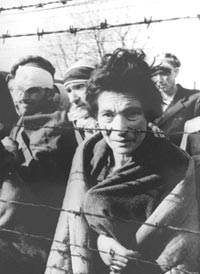
3. Satan: A third source of the evil we experience is Satan. Some people resist the concept of such an evil spiritual being. I understand that. It is not a pleasant possibility to consider. However the Bible teaches that humans are not the only ones who have rebelled against God and one source of suffering comes from the evil one who was the first to turn against God. You may learn more about the one the Bible calls Lucifer or Satan ("the accuser") in passages such as Genesis 3; Isaiah 14:12-15; Ezekiel 28:11-19; I Peter 5:8-9; Revelation 12:4-9. Satan seeks to turn God's paradise into a prisoner of war camp. Christ has come to defeat Satan on the cross, as demonstrated in the resurrection. The announcement of that victory is evangelism, the bringing of good news. Much suffering remains because much of the world does not know, or perhaps does not believe, that Christ has set them free from the tyranny of the devil. Let me share this illustration from history:
During World War II, General Jonathan Wainwright was the only US General to be captured. For many long years as a prisoner in Mongolia, Wainwright wallowed in self condemnation for having surrendered. His body deteriorated, and he depended on a cane to move about. He continually felt a total failure for having given in to the enemy.
Ultimately, General MacArthur gained victory and World War II came to a close.
Meanwhile, far away in Mongolia, the news had not reached Wainwright. He didn't know that victory had been gained. In ignorance he continued to live like a prisoner of war. Eventually, an allied airplane landed near the POW camp, an American officer walked to the fence, saluted and said, "General, Japan has surrendered." With that information, Wainwright raised his head, limped to the commandant's office, and announced in a calm voice, "My commander-in-chief has defeated your commander-in-chief. I am now in control. I order you to surrender!"
The POW commandant rose, laid down his weapon and quietly surrendered. Without firing a shot, Wainwright took over, despite his emaciated, handicapped physical condition.
Satan will not ultimately be successful because of Christ. Yet Satan will perversely keep as many as he can in his kingdom of hell on earth as long as long as our authority in Christ remains unknown or unclaimed. As long as the ruse is accepted, evil keeps the upper hand.

Recognizing these sources of suffering help some turn to Christ: While God is willing to forgive, freely in Christ, those sins we choose through the exercise of our free will, God may also allow us to experience the consequence of our sin for a season in order to prompt us to repent (i.e. to turn around, go in the opposite direction) and seek the forgiveness we need. This is for our good. Jeremiah however clearly reveals God's heart: "He does not willingly bring affliction or grief to the children of men." (Lamentations 3:33).
Nor is God unjust in this. God does not in fact "owe" us forgiveness, as Jeremiah recognizes in Lamentations 3:42: "We have sinned and rebelled and you have not forgiven." Forgiveness is not "owed" us but rather a gift based on Christ's merit, not our own. God may allow us this painful experience in order to call us back to the Righteous and Holy One against whom we have by the free choice of our will rebelled.
But why does God allow evil to continue until Christ's return? (Christ's return is described in Matthew 25.) God alone knows the reasons for His timing. But here is my understanding from the Scriptures:
a) The delay in Christ's return is to give opportunity to those in sin's grip to repent. The consequences of evil are so destructive that God wants no one to experience them in eternity, but gives time now to turn and accept his grace in Christ. (2 Peter 3:8-9)
b) The delay in Christ's return is to avoid destroying people who have chosen evil. After the flood God promised He would never again destroy humanity in His holy requirement to confront evil (Genesis 9: 9-17). Rather, God chose the way of redemption to rescue us from the evil of this age in Christ (Galatians 1:4).
The Gospel is God's Solution to the Problem of Evil
The Problem of Evil does not overcome the Gospel, rather the Gospel is God's solution to the Problem of Evil. The work of of the Gospel and in those following Christ in confronting and overcoming evil can be seen both in the work of Christ and His followers:
-
Christ's healing ministry and authority over demonic forces (Matthew 8-9)
-
the overcoming of evil in Christ's self-sacrifice on the cross (Matthew 27)
-
the death of death in the resurrection of Christ (Matthew 28)
-
the forgiveness of sin and the new birth in Christ (John 4)
-
the social outcomes of the Gospel despite opposition more...
1Youth Catechism of the Catholic Church, Ignatius Press, San Francisco, 2010. Location 51.
 Murray Moerman (