 Atheism
Without God, the universe will, in the end, be eternally dark and lifeless. That may appear unavoidable to some or to others not matter.
 20th century atheism
expressed in Marxism, according to Aleksandr Solzhenitsyn
(author of Gulag Archipelago), has not only failed but
done so at the cost of millions of
lives. That, it seems to me, should matter to everyone. (Click
on the chart, left, for an overview of human evil rejecting
God.)
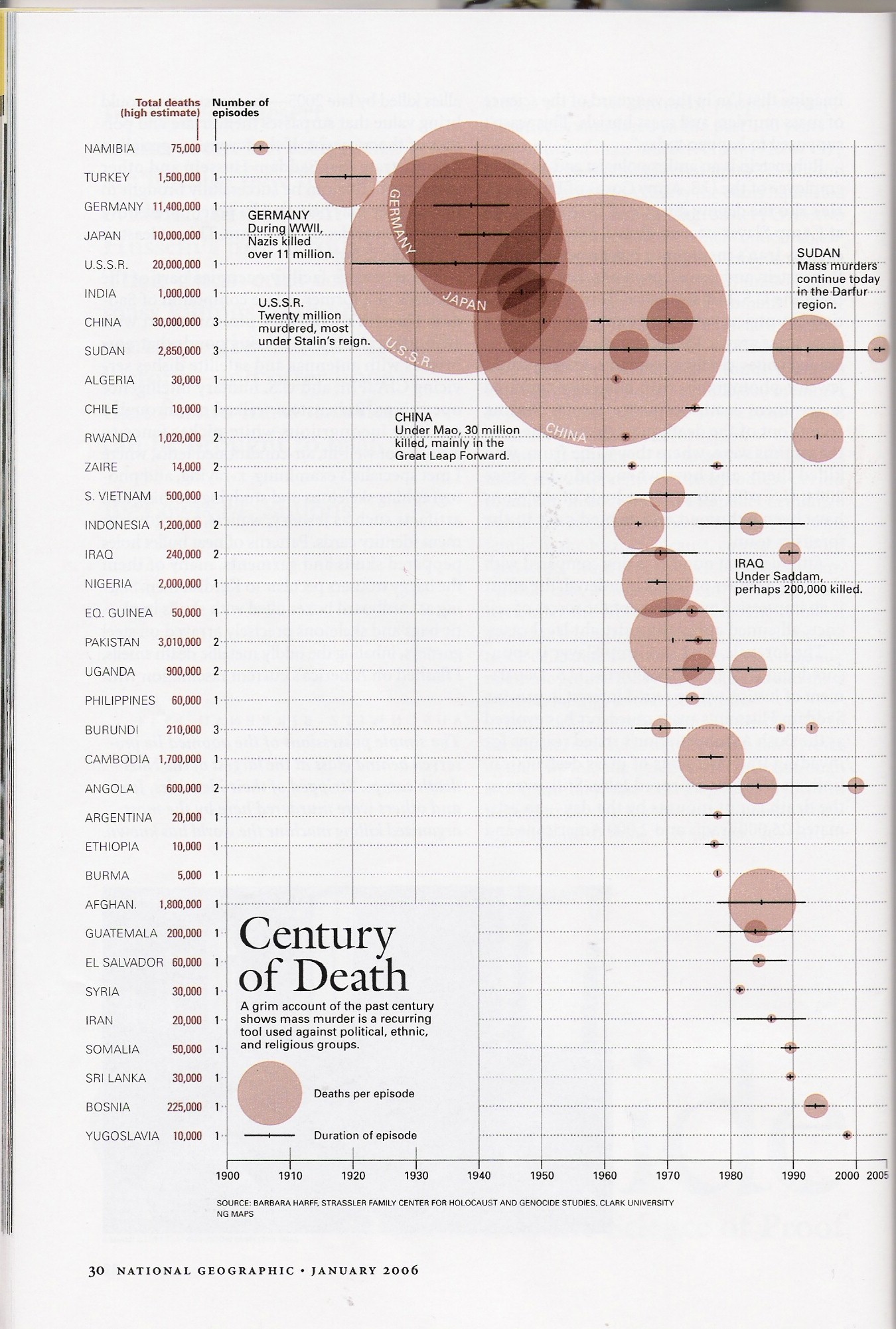
20th century atheism
expressed in Marxism, according to Aleksandr Solzhenitsyn
(author of Gulag Archipelago), has not only failed but
done so at the cost of millions of
lives. That, it seems to me, should matter to everyone. (Click
on the chart, left, for an overview of human evil rejecting
God.)
Yet it is ignored in 21st century atheism which has grown publicly more aggressive in a spate of books, bus billboards, court challenges etc.
I confess it's not clear to me why it would be important to my atheist friends to convince others to believe ultimately in nothing but oneself. There is is nothing obvious - either in state-enforced atheism (Marxism/communism) or in individual lives voluntarily choosing to believe in nothing but oneself - that appears strongly appealing.
Nor does research support the social benefit of atheism. In one of Project Canada's studies, for instance, researchers compared the attitudes of theists (including, but not limited to followers of Christ) to atheists in Canada. Researchers found that believers in God, however generically, were up to twice as likely to hold community-building values-such as honesty, kindness, family life, being loved, friendship, courtesy, concern for others, forgiveness, patience and generosity-as atheists.
While this may be surprising neither to atheists or to theists, the candour of motivation and subsequent logic involved in the decision to deny God expressed by one prominent advocate, was to me refreshingly more so:
"I had motives for not wanting the world to have a meaning; consequently assumed that it had none, and was able without any difficulty to find satisfying reasons for this assumption . . . . For myself, as, no doubt, for most of my contemporaries, the philosophy of meaninglessness was essentially an instrument of liberation. The liberation we desired was simultaneously liberation from a certain political and economic system and liberation from a certain system of morality. We objected to the morality because it interfered with our sexual freedom." (Aldous Huxley, Ends and Means, first published 1937)
A more recent thinker, Thomas Nagel, expresses his motive this way:
"I am talking about something much deeper-namely, the fear of religion itself. I speak from experience, being strongly subject to this fear myself: I want atheism to be true and am made uneasy by the fact that some of the most intelligent and well-informed people I know are religious believers.... It isn't just that I don't believe in God and, naturally, hope that I'm right in my belief. It's that I hope there is no God! I don't want there to be a God; I don't want the universe to be like that.[1]
It is this desire for autonomy without ultimate accountability which appears to be the driving force for the contemporary insistence on presenting students with selective information in biology and astronomy leaving out evidence for intelligent design.
Science was born in the Christian worldview of the universe as the product of God's purposeful order. Christians therefore generally welcome the fruit of science as it progresses and over time overturns earlier theories with theories which better explain newly discovered evidence. This process however must be, if it is to be science as generally understood, objective and conclusions to be suggested by the evidence, rather than by the previously determined views of the person selectively seeking evidence which fits his or her preconceived motivation as expressed by Huxley.
It is true that the heart has reasons of which the mind knows not. But the mind should seek out its heart for those reasons and invite it to be as candid as Huxley.
Some of the reasons of the heart which the mind knows not are are touched on by John Piper:
"When you take three
categories of temptation to self-reliance — wisdom, power, and riches — they
form a powerful inducement toward the ultimate form of pride; namely,
atheism. The safest way for us to stay supreme in our own estimation is to
deny anything above us.
This is why the proud preoccupy themselves with looking
down on others. C.S. Lewis said, “A proud man is always looking down on
things and people: and, of course, as long as you are looking down, you
cannot see something that is above you” (Mere Christianity).
But to preserve pride, it may be simpler to just proclaim
that there is nothing above to look at. “In the pride of his face the wicked
does not seek him; all his thoughts are, ‘There is no God’” (Psalm 10:4).
Ultimately, the proud must persuade themselves that there is no God.
One reason for this is that God’s reality is
overwhelmingly intrusive in all the details of life. Pride cannot tolerate
the intimate involvement of God in running the universe, let alone the
detailed, ordinary affairs of life.
Pride does not like the sovereignty of God. Therefore, pride does not like the existence of God, because God is sovereign. It might express this by saying, “There is no God....” (more)
A brief meditation of a friend invites atheists to be as honest about their uncertainties as they invite believers to be about theirs.
Blase Pascal was a seventeenth century mathematician who reflected on the decision of faith in terms which came to be known as Pascal's Wager.
Even the Friedrich Nietzsche, hostile as was his public thinking towards accountability to God in Christ, recorded private, candid moments as expressed in this poem (or prayer):
Once more, before I wander on
And turn my glance forward,
I lift up my hands to you in loneliness -
You, from whom I flee,
To whom in the deepest depths of my heart
I have solemnly consecrated altars
So that
Your voice might summon me again.
On them glows, deeply inscribed, the words:
To the unknown god.
I am his, although until this hour
I've remained in the wicked horde:
I am his-and I feel the bonds
That pull me down in my struggle
And, would I flee,
Force me into his service.
I want to know you, Unknown One,
You who have reached deep into my soul,
Into my life like the gust of a storm,
You incomprehensible yet related one!
I want to know you, even serve you. [2]
A fuller, light-hearted but powerful expression of a thoughtful honesty I would highly commend, is CK Chesterton's Orthodoxy available in the public domain in PDF or RTF.
Less light-hearted, and perhaps for that reason more powerful, is the journey of Peter Hitchens reflected in The Rage Against God: How Atheism Led Me to Faith, (Zondervan, 2010. ISBN: 978-0-310-41259-5).
----
[1] Thomas Nagel, as quoted in Alvin Platinga, "Why Darwinist Materialism is Wrong," The New Republic, November 15th, 2012.http://www.tnr.com/article/books-and-arts/magazine/110189/why-darwinist-materialism-wrong
[2] Friedrich Nietzsche, To the Unknown God. http://tapestrycommunities.org/2012/03/07/to-the-unknown-god-friedrich-nietzsche/
 Murray Moerman (