Murray's Blog 2012
Occasional reflections on the journey - from wherever we might be...
Or view entries from other years.
If you'd like to be notified of postings or make a comment, please send a note
December 25, 2012
If Christ had not Come:
In a December 25 devotional in Steams in the Desert, Mrs. Charles E. Cowman imagined Christmas without Christ. It was published with the title "If Christ had not come" and was founded on our Saviour's words, "If I had not come." The meditation told of a clergyman falling into a short sleep in his study on Christmas morning and dreaming of a world into which Jesus had never come.
In his dream he found himself looking through his home, but there were no little stockings in the chimney corner, no Christmas bells or wreaths of holly, and no Christ to comfort, gladden and save. He walked out on the public street, but there was no church with its spire pointing to heaven. He came back and sat down in his library, but every book about the Saviour had disappeared.
The doorbell rang, and a messenger asked him to visit a poor dying mother. He hastened with the weeping child and as he reached the home, he sat down and said, "I have something here that will comfort you." He opened his Bible to look for a familiar promise, but it ended at Malachi, and there was no gospel and no promise of hope and salvation, and he could only bow his head and weep with her in bitter despair.
Two days afterward he stood beside her coffin and conducted the funeral service, but there was no message of consolation, no word of a glorious resurrection, no open heaven, but only "dust to dust, ashes to ashes," and one long eternal farewell. He realized at length that "He had not come" and burst into tears and bitter weeping in his sorrowful dream.
Suddenly he awoke with a start, and a great shout of joy and praise burst from his lips as he heard his choir singing in his church close by:
O come, all ye faithful, joyful and triumphant,
O come ye, O come ye to Bethlehem;
Come and behold Him, born the King of Angels,
O come let us adore Him, Christ, the Lord.
Let us be glad and rejoice today, because "He has come."
December 20, 2012
The Reality of His Coming:
In our Christmas greetings to friends this year, Carol and I included this reflection on a contrast all the more striking at Christmas...
Vishal Mangalwadi, an Indian believer who lived several years in the USA recently observed: "The glitter could not cover-up the sad fact that America is reducing Christmas - the greatest event in history - to a mindless celebration of fictional characters from animal cartoons."
As a part of our Christmas morning with family, I plan to read the following from a German pastor who meditates on the costly redemptive purpose of God in his coming to us:
"Into the world He came; yes, into misery, into our filth. God loves the whole world, especially all that has become diabolical-the godless world! "The people who lived in darkness have seen a great light" (Matthew 4:16). It was to the desperate, the condemned, the damned, the murderous, the miserable, all those for whom there was no longer any consolation or hope, that Jesus came. They beheld the God who loves them. Light came into the darkness." - Christoph Friedrich Blumhardt, Jesus is the Victor
More about that later. In the 1840's a wonderful deliverance from Satan's destructive power over a young woman in the Black Forest region of Germany led to a remarkable experience of spiritual renewal and confidence in the victory of Christ over sin and sickness in the entire village. The shorter of the following two books is a theological reflection on the meaning of these events for us, the second is an account of the events themselves:
-
Christoph Friedrich Blumhardt, Jesus Is the Victor, Rifton, NY 12471, Plough Publishing House, 2011. 46 pages. www.plough.com/en/ebooks/j/jesus-is-the-victor
-
Friedrich Zuendel, The Awakening, Rifton, NY 12471, Plough Publishing House, 2011. 122 pages. www.plough.com/en/ebooks/a/awakening .
December 2, 2012
Discernment:
I was interacting off-line with a friend who processes
publicly on Facebook and makes decisions based on input received from
digital "passers-by." It caused me to reflect on my own experience
as a teen. I discovered that when I sought input on a problem or decision I was considering, I could choose the
input I wanted by asking the person I knew was likely to give me the input I
wanted. On Facebook one can get a wider range of input with less
predictability. For this reason its important to
choose friends (and
books) carefully.
In any case, as we receive input from an ever wider range in a global world,
it's all the more important to seek first to discern the Lord's voice in it
all. The best advice I've heard in that regard is that the first and
simplest voice is usually that of the Lord. The one that comes next and
sounds more like a lawyer is that of the one who works non-stop to draw us
away from Him. To hear and heed the voice of the Good Shepherd is
everything.
November 25, 2012
The Uniqueness of Christ and the Gospel:
As I was walking to my car recently, a stranger approached, offered a CD with hardly a word and moved on. I'm not entirely sure why I took it. It turned out to be a presentation of the uniqueness of the Christ and the Gospel. I don't think I've ever heard better. I hope you take the time to listen here.
The view that all religions are somehow "the same" or that the differences "don't matter" permeates western society, largely in my view, because of the underlying view that religion isn't really that important. Not so. Religion is the primary source of worldview and culture is founded on worldview.
I found this 45 minutes of teaching so important in fact that I bundled it with a few other things which I hope you will download here, copy to a CD and poke around a bit.
You may find yourself offering it to friends and strangers too.
November 18, 2012
Money Talks, but Don't Listen:
I've often heard people wonder aloud how a trillion dollar effort to understand cancer finds only the slowest incremental progress. Carol and I watched a documentary today showing how the cancer industry, piloted by the American Food and Drug Administration and National Cancer Institute, has been opposing a high degree of demonstrated success while its oncology poisons have lower success, but make more money.
The bottom line? Don't go with oncology but anti-neoplastons. But first watch http://www.burzynskimovie.com/index.php?option=com_content&view=article&id=110.
November 17, 2012
Discipleship:
Discipleship is the process of transformation that changes us to be increasingly more like Christ through the Word (John 17:17), the Spirit (2 Cor. 3:18), and circumstance (Rom. 8:28-29). Growth is both mystical and practical; God has a part ("Only God makes things grow" 1 Cor. 3:7) but we have a part as well ("...put off...and put on," Eph.4:22-23). Discipleship is based on continual repentance ("Be transformed by the renewing of your mind," Rom. 12:1-2). It takes far more than Bible study to grow a disciple - it takes a balance of worship experiences, fellowship experiences, engagement with the Word, ministry experiences, and evangelism/mission experiences.
"Without balance there is no health, and without health, there is no growth." - Rick Warren (http://blog.exponential.org/2012/11/warren-on-discipleship)
November 14, 20124
Entropy and Human Pride:
Everything physical "winds down" - stars die, cars becomes rust, people become old and return to dust. The universal principle is known as entropy. This inconvenient truth flies in the face of human pride, the shaky foundation of the religion of evolution. Human pride desires to view itself as ever better, developing onwards and upwards. Cyclic worldviews (Hindu, Buddhist and derivatives) prefer the belief that nothing really changes. The problem is that neither is true.
Adaptation takes place, undoubtedly, in the face of environmental challenges and technology improves. That is certainly change, and much of it desirable, but it is not evolution. The reality is that God made us good, but the fallen world is now "winding down" until the renewal of all things in Christ.
A prime example is the current study of human genetic mutations. Counter to evolutionary theory, human genetics, rather than relentlessly improving, are in fact worsening, and at a rate which suggests the human race is younger than desired by the theory (external link).
Genetics seeks to reverse this reality by human intervention, including the merging of human genes with other species and artificial genes. The "if we can do it, we should do it" philosophy can of course be dangerous (as demonstrated by the ability to build an atomic bomb), as ethics generally lag behind science, and the effects of tampering with the gene pool remains unpredictable.
Better to accept the reality of entropy in the fall, set aside the human pride which insists on believing what is less and less believable, and turn to the unchanging God of grace in Christ Jesus.
November 7, 2012
America:
The American empire has never been large in geographic or historic terms. It's disproportionate influence has always been primarily moral, cultural, military and economic. In all these terms American power has peaked and is in decline.
The decision of the American people in yesterday's election in my view will hasten the decline and for that I am sad.
America was a great nation for a season. No other nation fought wars on two fronts demanding no territory for itself at the end of World War II, then pouring vast fortunes through the Marshall Plan into rebuilding the nations which had sought to defeat it.
America was built on a Constitution which acknowledged its dependence and responsibility to God. As an elementary school child, living temporarily in a country not my own while my father attended school in Michigan, I remember praying the Lord's Prayer daily in class and seeing the Ten Commandments posted on the classroom wall.
America's founders recognized the fallenness of human nature required carefully balancing the power of its three branches of government, which were designed to be equal, to keep power from becoming absolute in the hands of any one person or group.
It's constitution limps heavily and currently lacks the respect to be restored. The balance of power defined by its founders has been undermined by a presidency demanding greater than constitutional powers and an judiciary enacting laws in the place of it's legislative branch.
America's constitution prohibited any branch of government choosing the religion of the people, more specifically whether America should be Catholic or Reformation in Christian tradition, as European leaders of the era had sought to do, often by force, causing the Pilgrims to escape persecution by setting out in the Mayflower for a new world for religious freedom, landing in what is now Massachusetts at Plymouth Rock. The intention of separation of church and state never intended to abolish all accountability to God from the public square. Yet America, like most western nations, has chosen secularism as its religion and demanded supreme allegiance, even from God, to itself. Statism in America, as elsewhere, is always dangerous because it lacks accountability to standards higher than itself.
When Augustine saw the decline of his society he wrote The City of God to help Christians understand and make the essential radical adjustments. Justin Taylor provides includes (in an overview of books helping us understand and respond rightly in the context of our challenge here) this helpful summary :
A classic treatment of the relationship between Christians and the world is Augustine's massive tome, The City of God, written against the backdrop of the fall of the Roman Empire at the hand of the barbarians. Augustine distinguished between the eternal City of God and the temporal City of Man-two rival cities shaped by opposing loves and working toward different ends. Nevertheless, the dual divine command to love God and to love neighbor requires that we work for the common good of the City of Man, even as we are citizens of the City of God who proclaim the gospel to our neighbors that they might become our brothers. A contemporary examination of these themes is Two Cities, Two Loves: Christian Responsibility in a Crumbling Culture, by the late James Montgomery Boice.

Others who love America from afar see hope in the humbling process which we pray will lead our American friends back to primary citizenship in the City of God from which to serve the world God so loves. Click on the image (right) for such a challenge and prayer
As Jim Ray wrote today in the Vantage Point devotional: "You are not an insignificant pawn subject to the whims of a politician, but a powerful servant subject to the will of God."
The Gospel has gone far...
...but in an "uneven" way. If we were to divide the world today into nine
regions and look
at the proportion in each region which is 
-
evangelical,
-
non-evangelical (cultural, nominal) Christian,
-
"more reached non-Christian" regions (in which very few Christians live) and
-
"least-reached non-Christian" regions (in which virtually no Christians live).
The world could be depicted as in the chart on the right. The importance of this information is that it shows how our energies in evangelism, church planting and in the renewal of the church could be wisely distributed; the work of missions today.
The chart is the work of friend and colleague, Chris Maynard, a member of the GCPN research team.
Not everyone relates equally well to charts so this has been put into story form on YouTube, putting the task in heart-perspective. It is ideal for personal use, sharing in church youth group, home group or church missions program.
What is one specific way in which what you learned will change your behaviour?
Invite your family, church youth group, home group or church missions program to watch it with you.
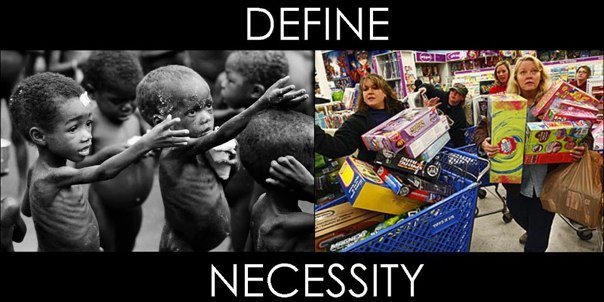
Redefining Our Needs and Opening Our Hearts to the Needs of Others:
To this I add nothing but to urge that each of us to identify one very specific way in which to respond accordingly today:
Compassionate Church Planting:
Recently a friend shared out of his experience helping plant churches in Columbia. Urban single mothers in that country are in great difficulty as they seek to support their children on low wages without the benefit of a social safety-net found in some western countries. Recognizing this need the new church put virtually all their limited resources into offering single parents childcare without charge. As a result about 150 children receive daily care their mother's can't afford. My friend commented: "When you love the community and meet a primary need there is no need to invite people to church. They just show up."
I like the motto of another church plant with similar DNA: "Planted in Community | Rooted in Truth | Reaching in Love". The purpose of church planting is to demonstrate, in community, the love and truth of the Kingdom of our Lord Jesus Christ.
What is a costly need in your city that your community of disciples can impact in love in a focused way?
Re-Focusing:
I woke often the night after a flight through 5 time zones and had time to pray asking the Lord to re-focus my life, which had again - as it so often does - become scattered as I'd gotten too busy in response to many demands and interests, overall good, but so many as to become scrambled. (I seem to have a problem with that.)
The Lord refreshed my heart in sharpening the three foci of my life which flow from His grace in the cross:
-
I want to love and worship the Lord in response to His great mercy; voluntarily sacrificing Himself as ransom substitute in my place to free me from the bondage and tyranny of sin, death and the devil, transferring me from the dominion of darkness into the Kingdom of His marvellous light (1 Col. 13). If I don't keep this relationship foremost the following two foci will not happen or grow in a distorted way.
-
The passion of my life is to have Christ continually formed in me (Gal. 4:19), more and more fully (2 Corinth 3:18), the hope of Glory (Col. 1:27). In that process I desire the Lord to purify my heart, not to be satisfied with the standards of the world, but to be like Him in every way (communion with the Father, love, faith, hope, holiness, power).
-
The work of my life is to draw as many as possible to Christ so they too may know His mercy and have Him gloriously formed in them for time and eternity, in the renewal of all things. I desire to serve God's redemptive purpose in conversation with individual pilgrims, with worshiping disciple-making communities, through the internet and church planting, particularly in the form of partnerships developing national initiatives.
The Lord Heals!
In August a generous, long-time dentist friend in Canada did needed work involving a bridge between my lower front teeth, which settled only slowly. Several weeks later in England I still needed Ibuprofen to sleep and increasingly needed it during the day also to continue to do my work.
One night in particular, despite taking Ibuprofen, a stronger painkiller and a sleeping pill, I was in much pain and slept little. (I sympathized and wondered what people 100 or 1000 years ago did in such circumstances. I remembered seeing the "dentist" chair in historic Barkerville, BC where whisky and "biting the bullet" were the only remedy.) Every indication was that a root was dying and I would need a root canal, something my dentist in England didn't want to undertake since he had not installed the bridge.
The next day Carol and I were with friends for dinner. I mashed everything to the consistency of thick soup. Our hosts were gracious. After the meal one of them invited an 88 year old woman with us at the table, who had seen the Lord answer healing prayer for a dental problem earlier in her life, to pray for my healing also. She did, along with Carol and the couple in whose home we were guests.
There was marked improvement within 24 hours! I took Ibuprofen only once more 6 hours after the prayer and probably could have done without it. From that day to this there has been no pain. The Lord has healed the dying root. May He be honoured as Lord, God and healer!
Read Much?
I've been struck by reports of how little most adults read, including many who have graduated from college. Some polls suggest a quarter of adults don't read a single book per year, and others that many of these adults don't read any books at all after graduation from high school or college. Whatever the precise details, I'm reminded of Mark Twain's quip: "The man who doesn't read good books has no advance over the man who can't read."

But what is a good book? A friend asked my opinion of a current best-seller. Does popularity or volume of sales make it a good book? I would suggest there are three kinds of reading we could do:
Necessary reading: is reading we all need to do to function in our culture and understand it. This includes newspapers and magazines and perusing at least some currently influential books. It's important to be aware of directions our culture is heading, both for ourselves and as we engage our non-Christian friends with the Gospel. Some of our reading in this category may be hostile to the Gospel. As Karl Barth once put it: "I read the newspaper in one hand and the Bible in the other."
Good reading: could include books which are entertaining, not opposed to Christian values and even generally wholesome but not particularly profound or impactful.
Best reading: moves beyond good. This is reading worth trading part of your life for. This is reading books which are genuine classics which have stood the test of time, Christian and otherwise (e.g. books such as Uncle Tom's Cabin, Grapes of Wrath, books by Charles Dickens and others which spoke to justice issues of their day), books which challenge and equip you to reach wider and higher for the sake of the Kingdom and God's glory, books which inspire us to be history-changers, healers, willing to choose the hard way and persistent in our following Christ in ways that make a difference to ourselves and others. Some of the books I feel are in this category are here.
While not everyone may agree on which particular books are 'best' or merely 'good,' my invitation is to:
- review your reading (do you keep a list?) and evaluate how you feel about the balance you see between these three categories in your reading and
- read more.
God and the Nations:
There is an amazing correlation between God's love for the nations and us. In fact, we can say little about God's love for the nations without our own involvement. Remember Isaiah for example: when in the temple Isaiah had a vision of God in which an angel asked a question born in heaven: 'Who shall I send, and who will go for us?' Isaiah recognized immediately that the answer had to do with himself (Isaiah 6).
Likewise the promise of God to give the nations, redeemed, as an inheritance involves us. Note the way this is expressed in a song of worship in which the first verse reflects God speaking to us about His mission on the earth, and the second verse our response:
HERE AM I
E G#m7
1.Ask of Me and I will give the nations
A F#m7
As an inheritance for you,
Bm7 B
As an inheritance for you, My children;
E G#m7
Ask of Me and I will give the nations
A B E
As an inheritance for you, ask of Me.
E G#m7
2.Here am I, send me to the nations
A F#m7
As an ambassador for you,
Bm7 B
As an ambassador for you, my Father;
E G#m7
Here am I, send me to the nations
A B E
As an ambassador for you, here am I.
--------------------------------------
Bob Kilpatrick / 1987 Kilpatrick Music
What is your next step? Have you written your life mission statement?
July 26, 2012Prayer Retreat:
Several of you have asked about my prayer retreat of the last two days. I confess that I've had prayer retreats more often previously and gotten "too busy" more recently. That has been to my detriment. It was one of the first things the Lord reminded me of. This from my journal:
"The Lord emphasized the priority of being with Him for guidance, including taking a prayer retreat like this more regularly. When I asked which of the questions (below) He wanted to address first, He was silent. Then I asked, "Are these the right questions?" He said, "It's not a science." Then I asked, What do you want me to do right now?" He said, "Just settle down and be with Me."
After a time I did go over the questions I had, listening for the Lord's heart, and added others to them relating to my overwork and need for focus. Some of what the Lord said was to the effect of: "Don't get so easily distracted by many 'good things' - focus prayer and energy on the centre of your calling and stop or hand-off most everything else."
I believe the Lord also gave dates for handing-off the lead role of two of my major responsibilities (May 2013) and (May 2014) though I don't yet know to whom. It may not be, in the end, my choice. I expect confirmation of these dates in future monthly prayer days.
July 24-25, 2012Did I mention that I've been too busy?
Well I have been and a friend challenged me to slow down in a prayer retreat to talk to the Lord about it and listen to what my Father in heaven may have to say. So I designated these two days for a practice I used to commit to more often.
Over the years when I've taken a day or two for prayer and listening I've generally taken only my Bible and a note pad, sometimes a book or two I've been reading related issues I'd been facing. Also I'd begin by writing down several specific and open-ended questions which I would bring to the Lord and listen for His voice.
As I begin this prayer retreat I'm 63 and facing issues of growing opportunity, danger of being overextended, and questions of transition of leadership roles to younger leaders at an appropriate time. I don't ever expect to 'retire' but know that some change is inevitable. So my questions of the Lord for this prayer retreat are these:
-
What do You want me to be before I die?
-
What do You want me to do before I die?
-
Is my workload too great?
-
What do I need to change?
-
What (responsibility) should I hand off?
-
To whom?
-
When?
-
What other questions do You want me to ask?
-
What else do You want to say?
You may want to try a prayer retreat of this kind. I've found them over the years to be powerfully reshaping at critical junctures of my life. I'm looking forward to this one also!
May 15, 2012
A Matter of the Heart:
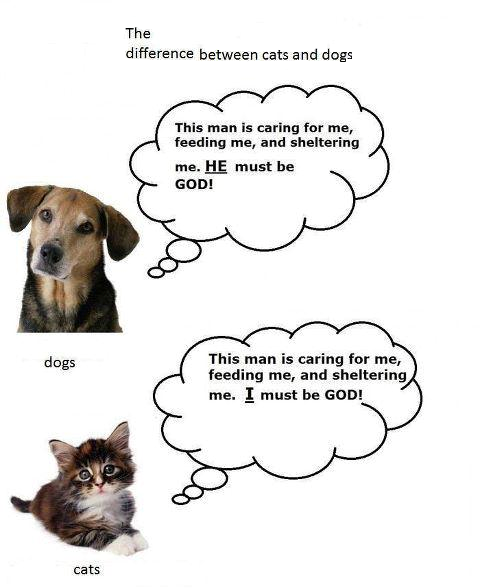
I'm surprised how often two people can see the same thing, be presented with the same evidence, or have the same experience and come away with radically different conclusions. In the end it appears that we chose to be in the centre of the universe and the measure of all things, or we chose to see ourselves as a part of God's universe and accept His perspective and measure of all things, including ourselves. The same is true of people's view of Christ as Lord, foundational moral issues, politics and economics, and many others matters. Why is this so? Sometimes these differences in response can be understood from the perspective of varying experiences, yet often these differences exist among people with similar cultural experiences. What then? God is not unjust in holding us accountable. Our response appears to be a matter of the heart, of human choice; that unique ability which is the free gift of God and determiner of destinies. Yet there are many who know not yet Jesus and with whom we need yet share His Lordship and matchless grace.
April 29, 2012
Catholic Renewal:
Carol and I recently participated in the 15th International Conference of the Catholic Charismatic Movement, near Assisi, Italy. (Assisi is the birthplace of Francis of Assisi, founder of the Franciscan Order, also widely known for his prayer and love of nature.) It's theme was "United in Christ for a New Evangelization." The unity referred to is that between Catholics, Evangelicals and Orthodox committed to world evangelization. Much positive change in the Catholic Church has emerged from Vatican II in recent years.
My greatest surprise was the
affirmation of these Catholic brothers and sisters of their unity with
evangelicals outside of the Catholic church. Prof. Matteo Calisi, president
of www.catholicfraternity.net,
explicitly stated the Catholic Church no longer expects Christians
outside of the Catholic Church to become members of it for unity to exist.
He affirmed also the contribution of the Reformation to the
Catholic Church in several vital areas including the authority of scripture, justification by
faith and the priesthood of all believers. Rather than seek structural
re-union, he asked all
Christians to work together for the evangelization of the world. Most
importantly, this is not the random view of an individual Catholic, but the
leader of a major renewal movement will the full support of Vatican
leadership.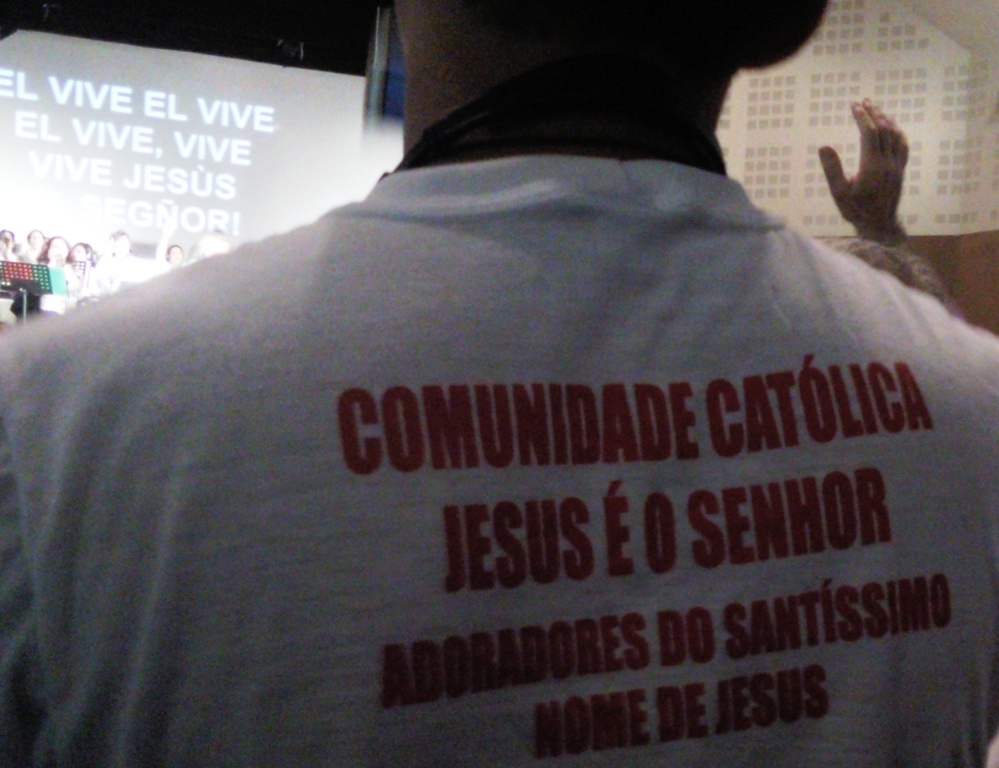 Remarkable also is the video on their site, with link to follow (since it
will likely be moved at some point), of an interdenominational charismatic
gathering when Carol and I were barely out of seminary, as a model and
inspiration for the relationship between Catholics and evangelicals as
brothers and sisters in the Body of Christ. The video clips total 13 minutes
and are available on YouTube
here - or in other formats on this site:
wmv,
mp4,
mov,
avi or
flv.
Remarkable also is the video on their site, with link to follow (since it
will likely be moved at some point), of an interdenominational charismatic
gathering when Carol and I were barely out of seminary, as a model and
inspiration for the relationship between Catholics and evangelicals as
brothers and sisters in the Body of Christ. The video clips total 13 minutes
and are available on YouTube
here - or in other formats on this site:
wmv,
mp4,
mov,
avi or
flv.
In addition, I appreciated the central focus on salvation through faith in Christ alone; the very evident respect for authority of scripture among these charismatic believers; their vital joy, practical love, and desire to live out biblical theology with constant reference to the biblical themes of personal and communal holiness, spiritual gifts (charisms), local mission, life as citizens of heaven with incarnational expressions through social service etc.
Evangelicals may well continue to point out areas of further renewal needed in the Catholic Church and be correct. Carol and I also met leaders in the Orthodox Church with the same desire. However the evangelical church must seek constantly its own renewal also and be willing to learn from the renewal taking place in other traditions.
One area of learning from current renewal in the Catholic Church I believe evangelicals can benefit from is living in community to focus energies on worship and mission. These communities are frequently residential but always covenantal, self-supporting and focused on a primary mission focus (e.g. reconciliation, the poor, street children, evangelism etc). They often have branches in other cities and countries and often on every continent. They are composed in largely of lay people;: couples, children and adult singles, with the blessing a church leader. The mission of many communities are supported by the tithes of its members.
Evangelicals have in recent years been challenged by Shane Clayburn to live in missional community but have been relatively slow to accept. One expression of the model resulting in slow reproduction has been its requirement, unlike Catholic lay communities, of outside funding. Other models in my lifetime have been the "Jesus People" communities of the 1960s and 1970s. I'm sure there are others but yet comparatively few.
Miraculous Movements:
You may be aware that many Muslims are turning to Christ for many different
reasons.
different
reasons.
The story is a remarkable one and part of it is well told by a friend in a partner ministry serving in Muslim nations in Africa. It includes dreams and visions, courageous obedience, persecution and details of a simple inductive bible study method focused on obeying what we learn and sharing it with others, particularly learning to discern the "person of peace" Jesus spoke of in Matthew 10 and Luke 10. Jerry Trousdale has written a clear and helpful account illustrated by many stories based on first-hand interviews. It is subtitled: "How Hundreds of Thousands of Muslims Are Falling in Love with Jesus." http://miraculousmovements.com
Please continue to pray for Muslims near you. This book will help you learn what to expect and how the Lord may well use you to bring His grace to them.
March 9, 2012
The Glory of God:
is wonderfully displayed both in nature and in grace. The following is time-lapse photography which calls me to worship in the spirit of Psalm 8!
The Life of flowers (Жизнь цветов) from VOROBYOFF PRODUCTION on Vimeo.
Then to the macro!
(If no longer on YouTube, click here.)
February 27, 2012
The Gospel and "Religion
Dick Hillis, the founder of the mission of which I'm a part (OC), once commented helpfully on the question of whether Christianity is a "religion":
"The dictionary classifies Christianity as a religion, but we must remember it's far more than that. Some schools teach a course called "Comparative Religions" and include Christianity among the many religions studied. This raises the question: can one compare the Gospel with religion or do we find more truth in contrasting the two? My missionary friend, Dr. John T. Seamands, gives some powerful contrasts in his book, "The Supreme Task of the Church":
Religion is man-made; the Gospel is God-given.
Religion is what man does for God; the Gospel is what God has done for man.
Religion is man's search for God; the Gospel is God's search for man.
Religion is good views; the Gospel is Good News.
Religion is good advice; the Gospel is a glorious announcement.
Religion takes man and leaves him as he is; the Gospel takes a man as he is and makes him what he ought to be.
Religion ends in an outer reformation; the Gospel ends in an inner transformation.
Religion whitewashes; the Gospel washes white.
Religion places the prime emphasis upon doing; the Gospel places the emphasis on a Person.
You can take Buddha out of Buddhism and Buddhism still remains with its four noble truths and its eight-fold path.
You can take Mohammed out of Islam and Islam is still intact with its five pillars of action and its six articles of belief.
But if you take Christ out of the Gospel there is nothing left, for the Gospel is Christ.
Wonderful further detail on the uniqueness of Christ and the Gospel in 45 minutes of audio teaching - the best I've heard in a lifetime here...
February 14, 2012
Statism
One would think it a truism that the state exists for the good of it's people. Unfortunately it's not so. Dictatorships for the good of the dictator abound (the head of the Palestine Liberation Organization died with over a billion dollars of foreign aid in Swiss bank accounts). Worse, states which harm their people, not only by neglect but by direct abuse, are many in history and today (cf. January 27, 2012 post). Unfortunately even nations where people are allowed to vote routinely overrule what the majority of their citizens see as best (e.g. California courts overturning a referendum asking homosexual unions not be viewed as marriage) and Obama's recent decision to force Roman Catholic institutions to pay for contraception contrary to their ethical code or earlier Canadian authorities forcing a Salvation Army hospital to kill unborn children resulting in the Salvation Army's decision to 'give' the hospital to the state and walk away in grief.
What an immeasurably great contrast is the Kingdom of God prefigured by Solomon's prayer in Psalm 72 that his rule be characterized by righteousness (v.1-4), peace (v.5-7), power (v.8-11), compassion (v.12-15) and prosperity (v.16-17) for the people revealing the glory of God to all the earth (v.18-20). While David and Solomon sought and made progress towards these goals, Solomon's prayer anticipates the coming of Jesus, the Son of David who proclaimed the Kingdom of God and called those who acknowledge him as Lord to disciple the nations. This call includes the "kings" of the nations, whereby we seek authentic relationship with members of school and town councils, state and provincial legislators and even prime ministers and presidents - beginning with prayer - introducing them to the Kingdom of God and inviting each to faithfully pursue their stewardship under God's reign in their care of the people he loves.
Where do we begin? As with all things in God's Kingdom, with ourselves, seeking the Lord for His righteousness, peace, power, compassion and prosperity in our own lives as a reflection of His character. We then seek also to contribute to modelling these blessings in the Christian community. And as able we will encourage earthly rulers to pursue these blessings of God in their stewardship of caring for God's people.
Idealistic? Yes. But far better than the alternative of statism.
Who is the person God brings to your heart? It may be a "king" in your own city or nation or half way around the globe. Remember intercession knows no distance, only a persistent, yearning heart.
January 27, 2012
Loss of Innocence
What should be our response to the inevitable loss of innocence experienced in life? This loss in too many ways grows in magnitude as we gain life experience. Loss of innocence includes awareness of our own propensity to sin, theologically expressed in Genesis 3 in the story of the fall. But in additional, this has been for me the growing discovery of the degree to which Satan has been successful in making certain times and places of the world hellish, belying the humanistic premise that people are essentially good.
Some loss of innocence is gained from personal experience (e.g. my trauma at being beaten by an Edmonton street gang at age 13). Some comes from history (the last century alone saw the Armenian genocide, two horrendous world wars plus many undeclared wars, 110 million deaths at the hands of various Marxist regimes, Cambodia's killing fields, the Nazi holocaust the Rwandan massacre, and much more) that we would prefer to forget. Loss of innocence expands and deepens painfully in the news where we learn daily of the horror of planned cruelty, violence, state-sponsored torture, war on civilians, bombing of hospitals, genocide, abortion, human trafficking, permanent refugee camps and more.
One response is to do all we can to put our head in the sand, deny and ignore, forget or try not to learn to begin with. At one level I have great sympathy with this approach because our human psyche and mental health is capable of awareness of only so much evil before it begins to do us harm, even at arms-length.
Loss of innocence, though inevitable, certainly shouldn't come too early. We should do what we can to protect our children through as much of pre-pubescence as possible. We should take ourselves away from unnecessary assaults on our spirits through movie depictions (previous post) and undue contemplation of evil.
But we must not ignore it or those victimized by such evils. My loss of innocence has repeatedly and more deeply galvanized me to Christ and the Gospel as our only hope of salvation, deliverance from evil, and the possibility of transforming the human heart, institutions and societies.
Often we cannot easily or directly touch the victims of these evils, but we can and must pray, stimulated and guided by such calls to prayer as for the vast prison camp which is North Korea. (Please click on the previous link, or the following for a call to prayer for Syria), and act as we are able.
God by His mercy has ended the Nazi holocaust, brought down the iron curtain and many other evils in response to prayer and courageous action. May our generation pray and act with greater urgency and sacrifice, not less.
January 14, 2012
To Copyright or Not to Copyright - a Great Solution:
When should a good idea be shared? One would think the answer is "always" - yet to protect the good idea - book or music - it has generally been copyrighted to prevent others from stealing, profiting unfairly or changing it in an unhelpful way. Yet copywriting an idea has often resulted in it not being disseminated and used as widely as it could, leaving humanity, and sometimes the Christian community, the poorer. The only alternative has been not to copyright one's work, which leaves one open to the possibility that someone else will do so, using their copyright of your work against you. Neither extreme seems to me to generally fit well.
For
 that reason I was delighted
to learn of a 'middle ground' in which one may retain control of one's
creative work while yet encouraging wide sharing, provided the author's name remains
attached and the content and integrity of that work is not compromised. Details
here. The
same applies to high quality photo images. You can contribute or download
the best photos and video and the same conditions apply. Explore
here.
that reason I was delighted
to learn of a 'middle ground' in which one may retain control of one's
creative work while yet encouraging wide sharing, provided the author's name remains
attached and the content and integrity of that work is not compromised. Details
here. The
same applies to high quality photo images. You can contribute or download
the best photos and video and the same conditions apply. Explore
here.
January 7, 2012
The Limit of Artistic Licence:
Stimulating the Imagination with Evil: During a recent airline flight I saw images of evil on screen I've not before seen on public media. It is not my intention to describe the images or debate the precise line where artistic licence should be limited but to suggest that media which stimulates the imagination with evil harms and degrades all humanity. The imagination is a powerful tool and when fuelled with cruelty and darkness unworthy of mention, it is empowered to imagine and do greater evil than it may have ever conceived on its own.
History is littered with examples.
Those who argue for artistic licence without limit traditionally imagine a non-existent wall between the depictions of evil and the evil it stimulates. The barrier simply doesn't exist and those who think it does need to prepared to be held responsible for the consequences of its impact on society.
Some will raise all the historic arguments against censorship, which essentially prohibits the depiction of specified behaviours. Yet virtually every law which exists is made to prohibit, shape or direct behaviour (e.g. driving laws, sexual harassment, violence in the school yard). To deny the legitimacy of restriction on human behaviour is essentially to deny the legitimacy of government and social ethics of any short.
If then we believe there is value in prohibiting specific anti-social behaviours through our legal system, why not limit the depiction and stimulation of those specific anti-social behaviour in various media? The difficulty of defining and enforcing the limits of artistic licence is in determining where one should begin - and "how much is too much?" I would encourage us rather than be hamstrung with the question to begin at the points of worst transgression. Anti-social behaviour simulated or stimulated by media may in reality be more harmful than individual anti-social acts because of the breadth of media's influence.
January 1, 2012
Stand by Me:
This one is mostly for fun. The video below synchronizes buskers around the world sharing in a song close to the hearts of us all as we stand on the cusp of a new year. It speaks to me also especially of the team with which I work, spanning many cultures, singing one song for the glory of the King!