Worshiping Together
Growing in Christ
There is richness in worship together with others, as well as privately and individually.
This page offers a wonderful process for leading God's people into a deep encounter with the Living God.
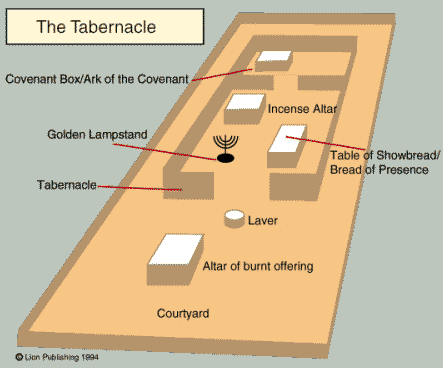
This means to a profound experience of corporate worship is inspired by the Tabernacle or "meeting place" of God with His people, given to God's covenant people, following their Exodus from slavery in Egypt.
This tabernacle (or "meeting place" with God) is depicted above. (For a more detailed depiction, please click here)
While the Tabernacle model was an Old Testament (OT) expression of worship with which Jewish friends will be comfortable, it is also the spiritual foundation on which the New Testament (NT) approach to worship rests (see Hebrews 9:1-15). The Tabernacle provides a powerful and deeply meaningful pattern for corporate transformational Christian worship - which can also be adapted for personal worship - as suggested in this song-prayer: Take Me In, elaborated in the following journey of worship:
Coming into The Outer Court:
1. Praising God:
OT: Songs of praise characterized God's people as they came from the community to the Outer Court of the Tabernacle.
NT: Opening prayer of praise followed by one or two lively and joyful songs of praise as we begin our journey to the throne of grace (Holy of Holies). These songs will focus on who God is: God's character and majesty. They invite people to Come and Worship
2. Recognizing the Body of Christ:
OT: As God's people walked towards the Tabernacle they greeted friends and relatives who also came to worship.
NT: In corporate worship it's good also to have informal time for family and friends to greet one another and introduce themselves to guests who may be present. This time of affirming the Body of Christ could take place with the aid of a song expressing the nature of God's people, a few moments of "mixing and mingling" or more substantially over coffee or tea with a snack or even a full meal.
3. Honoring the Sacrifice of Christ, the Lamb of God (John 1:29):
OT: Inside the Outer Court God's people then came to the Altar of sacrifice where animals were sacrificed in place of the sinner for their forgiveness.
NT: We now focus on Jesus Christ who gave Himself on the cross as the Lamb of God in our place. Our focus of thanksgiving may include sharing verses of scripture focusing on the cross and it's grace and power in our lives, prayers of thanksgiving for these and/or songs of praise and reflection on the Passover Lamb of God sacrificed for our redemption.
4. Cleansing:
OT: God's people then came to the Laver where priests could see themselves in the still water. The bronze bowl also served as a mirror. Here they washed themselves for service.
NT: Worship includes honesty with God about our behavior, our relationships and our heart's attitudes. To see ourselves as we are from God's perspective: both in our sin and in our redemption. Confession (Greek homologeo: "to say the same thing," to agree, concur) with God make take place privately in prayer or with a Christian friend (James 5:18), which brings fresh assurance of forgiveness/spiritual cleansing. The historic churches have developed many helpful liturgies relating to confession and cleansing. Many contemporary songs and prayers have been written and may be used at this point, e.g. Kingdom Song and a prayer.
In the Holy Place in the Tabernacle stood three items: the Lamp stand, Incense and Table of Bread of the Presence:
5. God's Word as Light:
OT: In the Holy Place oil-fueled lamps provided light. Psalm 119:105 speaks of God's Word in these terms: "Your word is a lamp to my feet and a light to my path."
NT: The Word of God is "alive and active. Sharper than any double-edged sword, it penetrates even to dividing soul and spirit, joints and marrow; it judges the thoughts and attitudes of the heart" (Hebrews 4:12), gives strength and direction for the path ahead and empowers us to grow in Christlikeness. A systematic approach encountering all of Scripture brings balance and fullness to Christian life and service. For aid in doing so in personal Bible study, please click here; to do so through Bible teaching in a corporate setting, please click here.
Songs aiding worship at this point might include such as Ancient Words or Soften My Heart in preparing to hear the Word or a reminder of the Gospel as a whole such as The Gospel of Christ.
6. Prayers of the Saints:
OT: In the Holy Place also stood an Altar of Incense which burned as a pleasing offering and aroma to God.
NT: As incense rises to God, so our prayers as His children rise as both an offering and a sacrifice to God (Revelation 5:8). These prayers can be planned or spontaneous, expressed by children or adults, in silence or audibly.
7. Communion:
OT: In the Holy Place also stood the Table of Bread of the Presence (Showbread) which spoke to God's people of the unleavened bread eaten the night of their exodus from slavery in Egypt.
NT: Jesus spoke of Himself as the Bread of Life (John 6) as He celebrated the Passover feast with His disciples (Matthew 26:17-30). This Passover celebration, in which Jesus gave Himself as the Lamb of God, Christians now call the Eucharist (which means "Thanksgiving"), Communion or The Lord's Supper. Christians generally view this celebration as a "sacrament" or "ordinance" but it was first known as a "love feast" i.e. a celebration of Christ's love expressed on the cross.
In the Holy of Holies in the Tabernacle stood one item: the Ark of the Covenant. Songs aiding worship at this point might include such as Open the Eyes of My Heart or Holy Ground.
8. Worship:
OT: Only the High Priest was allowed into the Holy of Holies, and him only once a year. It was the place to meet with God. The Ark of the Covenant contained elements relating to God's covenant relationship with His people. On top were depictions of angels (cherubim) with wings. The Lord spoke to Moses from "between the wings of the cherubim" (Ex 25:22)
NT: Jesus invited us to worship "in spirit and truth" (John 4:23). When Jesus died in sacrifice for us, the curtain in the Temple separating the Holy Place from the Holy of Holies was torn from top to bottom, symbolizing the reality we can now enter the Presence of God and meet with Him in worship in a place of deepest intimacy. In corporate worship now we have the privilege of enjoying His presence, sometimes in silent awe, listening to Him personally or corporately, allowing Him to speak to us, reflecting on what we have heard from His Word - resulting perhaps in further sharing of a word, a testimony, a prayer or a song. Many Christian traditions also sing or pray in the Spirit (1 Corinthians 14). It is important for a measure of spontaneity to be allowed as we respond to the Lord in worship from the heart.
A church Carol and I pastored for 19 years at the time of this writing projects this PPT slide during the spontaneous portion of corporate worship. It applies both to the previous and next aspect of corporate worship. This season of worship is be unhurried, comfortable with silence, listening, responding, loving, spontaneous, entering deeply into the heart of God.
9. Ministry of/to the Body:
OT: Ministry before Christ was largely limited to formal leadership, although there are hints of God's intention (Numbers 11:29)
NT: Christ however has given gifts of the Holy Spirit for ministry to all His people to enable us to minister to each other and to the world. (Many passages speak of these gifts of service: Romans 12; 1 Corinthians 12; Ephesians 4). Worship is wonderfully enriched when participants share their needs and are ministered to by their friends, so building Christ's Body for ministry to the world. This aspect of worship may be expressed in many ways including e.g. small circles of sharing of needs and prayer.
10. Benediction: receiving and carrying God's strength, love and blessing into the world...
OT: The most familiar blessing of the Jewish community is Numbers 6:22-24 but many other places in the OT show God's intention was to bless all the nations (Isaiah 61:11).
NT: Christians generally conclude corporate worship hearing (sometimes with turned-up hands) one or more of the many expressions of God's blessing from the Scriptures. This blessing brings personal encouragement and refreshment so we may carry Christ into the world and show Him there through His "love and rescue" mission.
 Murray Moerman (