
|
Growing in Christ "He opened their minds so they could understand the Scriptures." Luke 24:45 Overview of Old Testament or New Testament Links to observations drawn from other other books of the Bible |
|
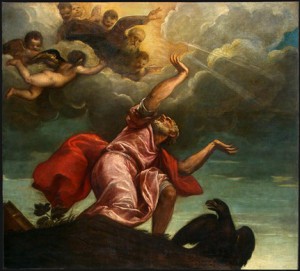
John shows Jesus in His cosmic perspective and significance.
Practical and Pastoral Observations on the Gospel of John (please read each chapter slowly and meditatively before reading observations below):
Introduction: The Gospel of John is about the identity of Jesus. John tells fewer stories than the synoptic gospels (Matthew Mark and Luke) but in greater detail. John is by contrast also more philosophic than the synoptics, placing Jesus into the larger context of the the Logos (v. 1) of the cosmos. Jesus' identity is highlighted in His statements regarding Himself:
- "I am the bread of life" - John 6:35
- "I am the light of the world" - John 8:12
- "I am the door" (to eternal life) - John 10:9
- "I am the good shepherd"- John 10:11
- "I am the resurrection and the life - John 11:25
- "I am the way, the truth and the life" - John 14:6
- "I am the true vine" (source of life) - John 15:1,5
These of course would be utter arrogance if Jesus was not God come in the flesh.
John 1
God alone is Source, Creator and Savior of all: God has taken the initiative to bring us light and life in Christ (v.3); glory, grace and truth (v.14). It is not we who sought God, it is God who sought us out in Christ. The Gospel is a "love and rescue" story.
The Identity of Jesus: The key question is to know Him who is God made flesh (v. 14); the Lamb of God (v.29); the One who baptizes in the Holy Spirit (v.33); the Son of God (v.34) and Son of Man (v. 51) - and to know ourselves mortal, sinful and in desperate need of His grace and truth. Only God could provide adequate substitute for the sins of all the world, only God-made-flesh could fully identify with those for whom He died.
As in Genesis 22, God provides the Lamb as substitute for us to carry away on the cross the sins of the world. I am am in need of the Lamb to substitute for me and I am called simply but radically to follow Him (v.43).
As we are forgiven and baptized in water, Christ will also baptize us with His Holy Spirit, v.33: "He upon whom you see the Spirit...remaining...baptizes in the Holy Spirit." We need Jesus as Lamb for us and His baptism in water and the Spirit.
The Significance of Jesus: cannot be overstated. God's grace in Christ is the basis of our salvation, justification, election, faith and spiritual gifts. He is what God intends humanity to be. Therefore we must aim high, as high as He is. Don't settle for mediocrity; only a little glory, grace and truth when God wants to give to you Himself in abundance. If the Gospel is true - and it is - then it is so radical as to impact everything in you and in the world and our future.
Jesus, the Word (Logos) of God: is the revelation of God Himself (v.1, 14). Jesus is all that God is and the full and accurate expression of Him, His heart, purpose and character. Cf. v.14: "The Logos became human (in Christ); we beheld His glory; full of grace and truth." Jesus, as the Word of God, is true always, to be heard, understood and obeyed.
The titles introducing Jesus are many in this chapter, inviting us to follow and worship: Word (Logos) (v. 1), God (v. 1), Creator (v. 3), Light (v. 7), only begotten God (v.18), Lamb of God (v.29, 36), Son of God (v. 34,49), Messiah (v.41), King of Israel (v. 49), Son of Man (v.51).
My Prayer: "Father, draw me always to Your light, even when it reveals my sin. I praise You for providing Jesus as Lamb of God for me
John 2
God wants to be known and knows we need help seeing through the distorted field of vision produced by sin. God graciously provides signs that we would recognize His hand and know Him. Turning water to wine is a sign of God's gracious heart and intention towards us (vs. 1-11); Jesus' cleansing of the Temple is a sign of God's desire for purity of heart and worship (vs.14-17).
"Signs" reveal who Jesus is and the Father He has come to Reveal. John prefers the term 'signs' to 'miracles' because the One to whom the signs point is more important than the signs themselves. The signs reveal Christ's mission and both the sign and Jesus Himself reveal the heart of the Father. It is the heart of the Father and the mission of Jesus which is the reason and focus of our day to day activity and life's work.
Our lives are to be and contain signs pointing to Jesus and the heart of the Father also. Some of these pointers will be miraculous as in v. 1-11, some will be acts of courage and truth as in vs. 14-17, and all will point to the ultimate sign and reality of the resurrection of Christ (v. 21) as first fruit of the renewal of all things.
Humanity needs redemption and cannot ultimately live or thrive without it. Jesus knew the nature of humanity (v. 24) and what was in the heart of man (v. 25). We too should have no illusion about the essential goodness of man or his trustworthiness (though the image of God in which we were created, distorted but recognizable, remains).
My Prayer: "Father, how wonderful, deep and wide is Your grace and manifold Your pointers and invitations to enter Your Kingdom. Thank you for the joy of being called to be an inviter!"
John 3
Jesus is from Heaven: Jesus descended to earth from heaven (v.13) and speaks of what He has seen in heaven (v.12) though not everyone understands or accepts what He speaks. The theme of Jesus' testimony (v. 11) is ongoing in John 3:31-36; 5:31-47; 8:12-20. Because Jesus is from heaven, He is Lord above all (v. 31) and has been given all things (v.35). Jesus knows the way to Heaven (John 14:6). We are in a posture of need: seeking, receiving, being filled.
For this reason I will seek out and listen to the Lord's testimony of what He has seen and heard in heaven (v.31-32). I will seek of the Lord from heaven "the Spirit without measure" (v.34). v. 34: "He (Jesus) whom God sent speaks the words of God (is the Word of God) and gives the Spirit without measure."
Heaven is the Source of Grace: All that is good; all that saves comes from God and is grace. v.27: "A man can receive nothing unless it has been given him from heaven." As Israel was saved when Moses lifted up the serpent in the wilderness (v.14) so Jesus is to be lifted up on the cross so that those who have confidence in Him have eternal life (v.15, 36).
Redemption and Judgment: Jesus doesn't judge the world (v.17), rather people judge themselves, i.e. those who reject their rescuer choose not to be rescued (v.19: "reject the light"); e.g. those on a sinking ship, are not judged by their rescuer, rather simply continue on the course they are already on. Their course is not altered. They are not not rescued. Why then do people reject Christ? v.19-20 because their deeds are evil, will be exposed, and require change (cf. Huxley's explanation). The theme of redemption and judgement (for those who reject redemption) is ongoing in John 5:22; 8:15; 9:39; 12:47.
My Prayer: Father give I pray a heart to hear and understand what Jesus teaches of heaven. Fill me Lord, heart and mind, with your Word, and with Your Spirit without measure. In Jesus' name.
John 4
True Worship: God is Spirit - and to be worshiped in spirit and in truth (v.24). May we worship rightly! The English word "worship" was originally spelled "worthship" denoting the worth and value of the One worshipped. While the Samaritans had built a temple on Mt. Gerizim to rival the temple built in Jerusalem, God is greater than location (v.21), so Jesus crossed social barriers of ethnicity, gender, and politics (v.7) to offer the woman living water/newness of life without any prerequisite change in her life (v. 10). This, so that she might be a worshiper - in spirit and truth - neither at Gerizim or Jerusalem (v.21) but in heaven.
The Harvest: Jesus gave himself entirely to the harvest (v.34), recognizing the fields to be ripe with those not yet gathered to the Father.
Initiative: When Jesus healed, He responded to the initiatives of those would appealed for help (e.g. v. 47), in contrast to evangelism, as with the woman at the well, where He took the initiative (v. 7). God is not limited by distance in acting powerfully in response to faith (v.52-52.)
Salvation is from the Jews (v.22). Jesus was a Jew and the Jews were the first messengers of the Good News (Acts 1-10).
Personal Application: I will be proactive, bold and direct as Jesus in inviting people to be seekers and worshipers. I too am a harvester committed to the joy of gathering fruit for eternal life (v.36). Like Jesus, (v.34) "my food is to do the will of Him who sent me, and to accomplish/finish/complete His work." I too seek to be so close to the Father that I know His intentions and am able to speak them (v. 50).
My Prayer: Lord, fill me with living water, the gift of God, welling up to eternal life. Through this gift grant me boldness, power and grace to offer it freely to others continually. Father, gather souls from the harvest for eternity, as I pray for the lost and seek to multiply disciple-making communities. Lord, in all things, empower me to grow in faith and knowledge of the intentions of Your heart, and the power to act that You might do the miraculous.
John 5
Jesus' absolutely unique relationship to the Father as Son of God was clear to the Jewish leaders of His day (v.18) and to us in Jesus description of this relationship in vs. 19-47.
Jesus sees and does what His Father is doing (v.19), Jesus raises from the dead (v.21) and has life in Himself as the Father has life in Himself (v.26), has been given the honor of judging the world (v.22-23, 27), though He will do so as His Father directs (v.30), and will call forth all the dead in resurrection to stand before Him in judgment (v. 28-29). No human is His peer.
Witnesses: The astounding claims of Jesus in this chapter require authentication (v.31). The witnesses Jesus offers are His Father (v.32, 37) [at His baptism and transfiguration], John the Baptist (v.33), his miracles (vs. 1-18, v.36), the OT Scriptures (v. 39) and Moses (v.46).
v.23: "...all will honor the Son even as they honor the Father. He who does not honor the Son does not honor the Father who sent Him." v.24: "Truly, truly, I say to you, he who hears My word, and believes Him who sent Me, has eternal life, and does not come into judgment, but has passed out of death to life. (These italicized words where chosen by my earthly father, John Moerman, to be inscribed on his gravestone.)
The mission of Jesus flows out of His relationship with His Father (v.17). Jesus declares His mission to be to do the will of the Father (v.30), seeing and doing what the Father desires to do, even to redeeming those utterly lost, on the cross.
Personal Application: I want to more clearly see the Father working and what the Father desires so that I might follow closely, acting as He acts. This is the essence of authentic ministry. I must point beyond God's call to justice and compassion in this life to readiness in Christ for judgement in the resurrection life to come (v.28-29).
My Prayer: Father, show me how to see what You see and are doing as Jesus saw. Show me how to walk as Jesus walked. Give me courage to point both to You in this life and in the life to come. Lord, thank you that I will not come into judgment but have passed from death to eternal life, which has already begun, from which to praise You forever.
John 6: 1-40
God-in-Christ is the giver of Signs (healing v.2, feeding the crowd v. 14, walking on water v. 19, instant transport v. 21) which draw, those willing to see (v.14), to Himself. Jesus is the True Bread, the Bread of God which comes down out of heaven and gives life to the world (v.33). Humanity will always be hungry and thirsty with out Him.
God desires to feed His people the True Bread (v.32) which gives them eternal life (v.27). Therefore Jesus came to do the will of His Father, which is to give eternal life (v. 40), lose none who the Father has entrusted to Him (v. 39), and raise us up on the last day (v. 39-40). Jesus will never reject the one who comes to Him (v.37)
v.40 "This is the will of My Father, that everyone who beholds the Son and believes into (aligns himself with) Him will have eternal life, and I Myself will raise him up on the last day."
Personal Application:
-
I will believe in Christ sent by the Father (v.29).
-
I will not be afraid (v.20).
-
I will come to Him (v.35), behold Him in awe and believe (v.40).
-
I will work for the food which endures to eternal life (v.27), (i.e. believe in Christ the giver v. 29) and encourage others to do the same. This encouragement of others includes evangelism, biblical teaching, discipling and pastoral care.
My Prayer: Lord, give me eyes to see the signs of Your presence and purpose, drawing me always to the True Bread from Heaven (v.34) which is Yourself. You are the Way, Truth and Life. Enable me to align myself with You continually, turning as needed to stay aligned, enter fully into and continue in the Way which is Yourself. Thank you for coming into the world to do the will of the Father to forgive, reconcile, give and raise us up into life eternal.
John 6: 41-71
The Gift of Life from Heaven: God the Father is and has "life in Himself" (John 5:26) and has given it to His Son who lives because of His Father (v.57). We have no everlasting life in ourselves (v.53) but Jesus comes down from heaven (v. 41, 51) and gives this life by the sacrifice of His body (v. 51) on the cross. The Father draws us to Christ to receive His gift (v.44-45) and keeps us secure in Christ (John 5:37,39) through eternity. We are invited to believe (v.29) it to be the work of the Father (v.44-45, 65), and the Spirit then quickens (or vivifies) eternal life in us on the basis of the truth of His word (v.63).
The Gospel: Jesus makes clear our essential helplessness (we have no life in ourselves, v.53), and the sovereign grace of the Father (v.44-45, 63) through His self-sacrifice for us (v.51). This is the Gospel. We do not form or shape the Gospel, nor do we have liberty to alter it. If we did, the altered result we offered would cease to be the gift of God. We are called however to share God's gift as it is, never to compromise or dilute it with anything or anyone else (which would be idolatry).
v.51: "I am the living bread that came down out of heaven; if anyone eats of this bread, he will live forever; the bread which I will give for the life of the world is my flesh."
My role: I will hold to the core, draw on Christ alone, defend the Gospel to those who would alter it, and praise God eternally for His gift to me, a helpless sinner.
My Prayer: Praise you Lord, for your grace beyond expression! How magnificent, how marvellous! How beyond the ability of man, with the efforts of his philosophies, to find out. Thank you for the gift of heaven, the Living Bread, to give life to all who will receive. Empower me to proclaim Your Gospel and goodness to my last breath!
John 7
The Gift of the Father: God the Father is true (v.28), wants to be known (v.29) and reveals Himself in sending the person of Jesus (v.29) and through Jesus' teaching which point back to Him (v.16-17). Jesus is the source of abundant 'living water' (v.38), alive as is everything in heaven, and life-giving to those who receive Him.
Welcome and Rejection: The mission of Jesus brings division between those who welcome and reject His offer of grace and revelation (7:43; 9:16; 10:19). We must therefore have courage to speak the truth (v.28) and if need be hated (v.7), yet doing God's will (v.17) and confirming Jesus teaching. Our strength and refreshment in life and opposition comes from "living water" from heaven flowing from Jesus (v.38).
Living Water: The first 7 days of the Feast of Booths water from the Pool of Siloam was carried and poured into a silver basin by the altar. The 8th day this was not done making Christ's claim and offering all the more startling: v.38: "He who believes in Me, as the Scripture says, "From his innermost being will flow rivers of living water.""
My Prayer: Lord, give me such love for You that I'm never tempted to reconsider when inevitable divisions arise. Give me of Your Holy Spirit in such measure that I would have strength always in the face of opposition and danger.
John 7:53 - 8:11 is a event from Jesus' ministry inserted at this point for reasons not entirely known. Perhaps it is interted here as an example of the kind of interaction with the Pharisees which, in the context of Jesus' claims of intimate relationship with His Father, infuriated them further, leading to Christ's crucifixion. (The flow of the Pharisee's debate with Jesus should also be followed from the Pharisee's challenge in 7:52 directly to Jesus' claim to be the light of the world in 8:12.)
God is both gracious and righteous (v.11). As such Jesus humbled the arrogant and forgave the humbled. v.11: "Neither do I condemn you. Go and from now on sin no more."
Jesus is the fulfilment of the Law: Jesus did not reject the death penalty for adultery because it had ceased to be sin but because he was the fulfilment the law (Matt. 5:17). Our mission of grace is based on His fulfilment of all things on the cross.
Living the Gospel: I will not be drawn into a false dichotomy, choosing between grace and righteousness. I will flee self-righteousness, judgment of others and the inner view that I am better than others. At the same time and with equal purposefulness I will seek to live righteously and invite others to follow Christ with me in all righteousness and grace.
My Prayer: Lord Jesus, pride runs so deep, even in the heart that has known your forgiveness. Forgive me for comparing myself favourably with others. Forgive me for putting righteousness ahead of grace or of being drawn into false dichotomies at the expense of people's need or your righteousness. Help me learn and live this vital lesson moment by moment, day by day.
John 8: 12-30
Setting: When Jesus taught in the Temple he often did so near the Treasury, where offerings were collected, in the front Court of the Women (see below, added not because Jesus endorsed the Temple, actually He came to remove it's necessity through Himself being the once-and-for-all sacrifice, but) so that both men and women could hear him (Mark 12:41).
During the Feast of Booths, sixteen gold bowls filled with oil and lighted. Jesus used that image and moment to declare he was the light of salvation not only to Israel but to the world.
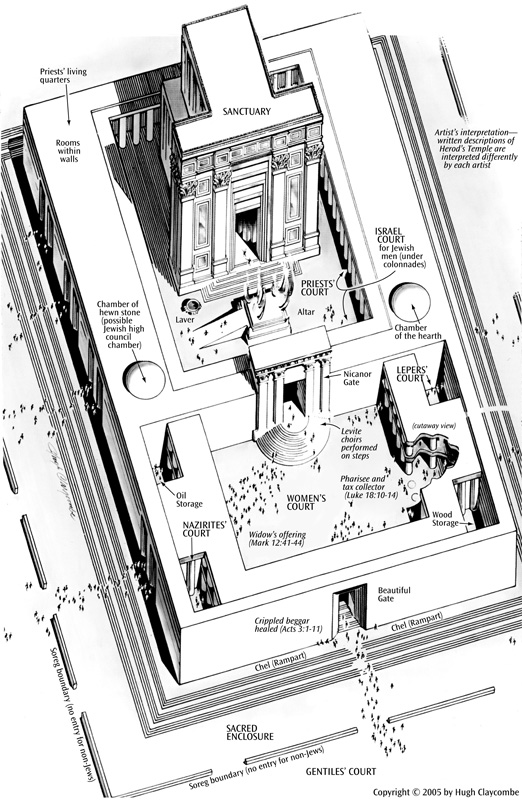
Light of the World: Jesus is the light of the world (v.12). This light is not from this world but from above (v.23) [we too must be born from above by the Holy Spirit (John 3:3,5]. Jesus has been sent from the Father (v.26) and speaks what the Father has given Him to reveal (v.16,26-29). Jesus therefore knows where He came from and the destination to which He will return (v.14); therefore He is the true, living way to the Father (John 14:6). If we know and follow Jesus, we know the way to the Father and know Him (v.19). If we refuse this grace, we cannot go where Jesus is going and will die in our sins (v.21,24).
Following the Light of Christ: I will follow the light of Christ and point always to Him so others may see and follow also. In so doing am not to condemn sinners v.15 ("throw stones" v.7), but give thanks to God for His grace in Christ, leave all judgement to the Father and point to Jesus who forgives (v.24). I will listen to Jesus speak the Father's heart and do what is pleasing to Him (v.26-29) though I will be resisted as Jesus was.
Deity of Christ: Jesus declared "...unless you believe that I AM He, you will die in your sins" (v. 24). This I AM is again reminiscent of and an identification with the Father's declaration in Exodus 3:14.
My Prayer: Father, thank you for the Light and grace of Christ leading to You. I praise You for making the way in Christ that I may follow to where He is, above with You (v.21-23). Keep me from the agitation of trying to decide between many things which need doing; rather to hear You, follow in peace and do those things pleasing to you.
John 8: 31-59
Jesus and the Father: Jesus knows the Father (v.55) and is sent by Him (v. 42). As such Jesus keeps His Father's word (v.55) and is glorified by Him (v.54). Before Abraham, Jesus was one with the Father and uses His divine personal name: I AM = Yahweh (v.58; Exodus 3:20).
Decisive Influence of Our Father: As we live in the truth of Jesus' Word we come to know the Father (v.47) and will not walk the path leading to eternal death (v.51,52). Jesus makes us free from sin (v.34-36) as we abide in His Word (v.31-32). Jesus refers to a basic observation of life: we are greatly influenced by our Father and tend to do as he does; Jesus does as His Father directs (v.42), the Jews who resisted Jesus did as their father the devil does (v.44); in all things our father is revealed by our actions.
Word of the Father: I will listen for the word of my Father (v.43, 47) because I am of [belong to] Him (v.47). As I abide in His Word (v.31) I am freed (v.32) by the Son (v.36) from sin (v.34) and death (v.51,52).
v.31b-32: "If you abide in my Word, then you are truly my disciples and you will know the truth and the truth will make you free (from sin)."
My Prayer: Father, thank you that as I walk in the word and way of Jesus I am becoming like you. All you have given - life, forgiveness, paradise - are gifts from you. All glory is therefore to you! High King of Heaven may all my life point to You my Father. In Jesus name, Amen.
John 9
Jesus Identity: The core issue of the chapter is Jesus' identity. Jesus receives worship (v.38), is judge (v.39), healer (v.7) and light of the world (v.5). Because Jesus is denied His identity and roles by some, He brings division (v.16) among those who must decide.
All suffering is due to the Fall, but not all suffering is caused by
personal sin: The distinction between one worthy of compassion and
one whose trouble is due to weakness of character (sin) does not stand;
God loves and wants to heal both the external trouble and the inner
character. Jesus directly challenges and overcomes in healing the false
assumption that all sickness and suffering is the consequence of one's
own sin in this life (v.3). Implicitly Jesus rejects also the
notion that suffering is the consequence of sin in a previous life, i.e.
reincarnation. (Cf. also Hebrews 9:27). The Pharisees however return to
the notion of suffering as consequence of sin (v.34), denying the
implications of the blind man's healing.
True Enlightenment in Christ: We should not jump to the conclusion that a person's trouble is due to their own errors and shortcomings, (though sometimes it is, in our own lives and those of others). We must therefore watch for dangerous blind spots; the blind man who was assumed to be in spiritual darkness could see God's light, whereas the Pharisees, who could see physically and thought themselves enlightened, were shown to be spiritually blind (v.30-34, 40-41).
Personal Application: Rather than judge superficially, I will pray for and serve the needy and do the works of Him who sent Jesus while I am able (v.4), recognizing opposition may follow my confession of Christ: v. 25 "one thing I know: though I was blind, now I see."
My Prayer: Father, give me eyes to see the works You want to do, and compassion and courage to do them.
John 10:1-21
Jesus' Self-Description: This chapter contains many of the "I am's" with which Jesus identifies Himself (see introduction). Jesus is the "door" (v.7) leading to abundant and eternal life; He is the "Good Shepherd" (v.11) who voluntarily lays down His life for the good of his sheep; He is the "owner" of the sheep (v.12) who sees the wolf (Satan) and the damage he can do, "knows His own" (v.14) and gives His life to protect them.
(The fold of the sheep was a walled enclosure open to the sky, with one entrance containing several flocks. The fold was guarded by a gatekeeper and each morning the shepherd called his flock out from among the others. Only the sheep of his flock responded to his voice.)
Jews and Gentiles: Jesus said v.16 "I have other sheep, which are not of this fold; I must bring them also, and they will become one flock with one shepherd." In this He spoke of His calling to bring both Jews and Gentiles (all religions) to the Father in Himself.
Personal Application: What I must most avoid is the false heart of the hired hand (v.12) who doesn't see the wolf coming and lacks the courage to resist and overcome him when he attacks the sheep. I will continually trust the good shepherd, fine tune my heart to know His voice and its every nuance, and promptly obey - for my life and well-being depends on it. My greatest ministry is to hear His voice (v.3) and to continually point people of every flock (religion) to the Good Shepherd.
My Prayer: Jesus, thank you for giving me ears in my heart, grant me to know your voice, quickness to obey and joy as I do.
John 10:22-42
Jesus' Self-Description: Jesus could not be clearer about His identity and relationship with God the Father (vs.28-38). "I (Jesus) and the Father are one" (v.30, "one" is in the neuter form ruling out the meaning that they are one person), "the Father is in Me, and I in the Father" (v.38), "I am the Son of God" (v.36). As such Jesus is able to "give eternal life" (v.28).
Our Response:
-
Those Who Oppose Him: The fact that Jesus is clear about His identity is evident in the fact the religious leaders wanted to stone Him (v.31) and later to seize Him (v.39) for similar purpose. How did Jesus escape? His opponents were certainly in the majority. The text doesn't say but Jesus would choose His time to die as Passover lamb.
-
Those Who Receive Him Gladly: My response rather is that I believe Jesus as He is; I am His sheep, hear His voice, follow Him into (receive from Him) eternal life, will never perish, will never be snatched from Jesus' or the Father's hand (v.25-28). These are glorious truths and experiences which make all the evils of the world endurable. For these reasons I listen, believe and follow; I am utterly and eternally secure in Him. (vs.25-30)
My Prayer: Praise you Lord, that eternal security is not a doctrine to be debated but an experience in which to rejoice.
(The Feast of Dedication (v.22) was instituted 165 BC to celebration the re-opening and dedication of the Temple by Judas Maccabeus after its desecration by Antiochus Epiphanes in 168 BC (Daniel 11:31; 1 Maccabees 4:51-59). The feast is also known as the Feast of Lights or Hanukkah.)
John 11
The Identity of Jesus Christ: Jesus is the Son of God (v.4, 27), the Light of this world (v.9), the Resurrection and (eternal) life (v.25); the Messiah (in Hebrew) = Christ (in Greek) (v.27) who would die "in order that He might also gather into one the children of God who are scattered abroad" (v.50-52).
Our Response: My task and calling is simply but profoundly to believe in Jesus (v. 26) whom the Father has sent (v.42). All who believe in Him have everlasting life (v.25-26): "I am the resurrection and the life; he who believes in Me will live even if he dies, and everyone who lives and believes in Me will never die."
As I share the Gospel and face opposition as Jesus did, I will not be intimidated, knowing that the resurrection of Christ is greater and will overcome all. The resurrection of Christ has given courage to believers throughout the ages, cf. the prayer of St. Patrick in which he places this great strength between himself and all great evils of the world (click here).
My Prayer: Lord, what amazing grace and power, even over death eternally, is in You! Help me every hour to walk in the light (v.9). Give me courage to fear no evil, even that I discover lurking within, knowing that You are greater!
Prophetic Word:
Caiaphas, a political collaborator with Rome, feared the violent Roman
response to an uprising of the Jewish people to make Jesus King, a
response which would remove the privilege of his role and class. He
could hardly however have realized the full meaning of his own pragmatic
words in v. 50, pointing to the very substitutionary atonement of Christ.
John 12: 1-26
Jesus Understood and Misunderstood: Jesus enters Jerusalem in fulfilment of Zech 9:9 but is misunderstood by the masses. The crowds urge Him to save them from Rome on with the cry "Hosanna = save now" (Psalm 118:25f), but Jesus is not a political saviour. If Jesus had died as leader of a military revolt against Rome He would have soon been forgotten.
Mary, as a friend and witness to the miracle on behalf of Lazarus, understood Jesus better. She may have been aware of the words of Caiaphas (John 11:49). In an expression of honor and perhaps worship (v.3) which Jesus affirms as anointing for burial (v.7) as sin-bearer of the world, she anoints His feet and weeps over Him.
Glory is not Eclipsed by Suffering: In all things the Father glorifies His Son (v.28-30) and the Son glorifies His Father by doing and saying as His Father directs (v.49-50). There may be cost associated with doing so, as Lazarus experienced (v.10): tradition has Lazarus escaping to Cyprus where he led the church and is buried.
Personal Application: I too want to glorify the Father by glorifying His Son, trusting Jesus, being a "son of light" (v.36) and bringing people to Him (v.21). Our costs will vary but there is no following without cost - and blessing (v. 24-26). As I follow, serve and remain with Jesus (v.26), I too may "fall into the earth and die" (v.24) but so bear much fruit (v.24), receive life eternal (v.25) and honour (v.26). Regardless, I will follow and glorify Him.
v.25,26: "He who loves his life loses it, and he who hates his life in this world will keep it to life eternal. If anyone serves Me, he must follow Me; and where I am, there My servant will be also; if anyone serve Me, the Father will honor him."
My Prayer: Lord, may I serve and follow and be where You are, through every day of life and through death into life eternal.
John 12: 27-50
Jesus' identification with the Father is amazing: those who believe in Him, believe in the Father (v.44), those who see Him, see the Father (v.45), those who hear Him, hear the Father (v.49-50). As such, Christ came to cast out the ruler of this world (v.31), save the world (v.47), draw all men to himself (v.32), speak the words of the Father (v.49), glorify Him (v.28) and bring eternal life (v.50).
Jesus is the Light and enables us to walk in the Light. As such, we are "children of Light" enabling us to know where we are going (v.35) and to show others as we follow Christ (v.36).
v.32..."I, if I am lifted up from the earth, will draw all men to Myself." v.45: "He who sees me, sees the One who sent me."
Judgement on Darkness: As the Light casts our the darkness, the ruler of this world is cast out (v.31). This judgement occurs not only on Judgment Day; it began when the light penetrated the darkness and unmasked it (3:19; 5:24; 9:39). Although Satan's final demise lies in the future, the work of Christ, the cross and resurrection, undercuts and unravels Satan's domain and is the basis for ultimate victory.
Personal Application: I will walk in the Light (v.35-36), listen and do the words of God-in-Christ (v.47), and I will love the approval of God rather than man (v.43), even unto death (v.25).
My Prayer: Lord, give me joy and courage to ignore the approval of men, to seek Your voice, walk in Your ways, overcome the ruler of this world and enter eternal life.
John 13: Jesus celebrates the Passover as He prepares for His death as our Passover Lamb.
Jesus mission is one of love. He loves His own to the fullest extent (telos) (v.1), not only in servant hood (washing feet), but in His self sacrifice for His own on the cross.
My mission flows out of His: I am identified with Jesus by welcoming His servant hood of me (v.8); I show I am His by loving as He loves me (v.34).
How much love? Love by this standard: "as yourself" (Lev.19:18). Self-love has no limit. To that standard I must love others: no limit, just as Jesus loved without limit:
... Love one another even as I have loved you...(v.34). By this all men will know that you are My disciples, if you have love for one another." (v.35)
This is the heart and standard of the Gospel.
Jesus was self-aware in this His Mission: I'm struck by how much emphasis is put on Jesus "knowing" (v.1-3) as a foundation for His self-sacrifice.
v.3: "Jesus knew that the Father had put all things under his power, and that he had come from God and was returning to God."
I must know that I am His and will be with Him. Faith is necessary for such love.
My Prayer: "Father I pray that I, like Jesus, might have courage for sacrifice with love, even with joy, for your glory."
John 14: Jesus teaches His disciples in preparation for His crucifixion in chapters 14-17.
Jesus prepares His disciples for His death, resurrection and ascension: a) Jesus promises to prepare for us a place in His Father's house (v.2) and lead us to it (v.6). Jesus is uniquely qualified to do this because He is in the Father & the Father in Him (v.10). b) Jesus promises the Holy Spirit to be with (v.16) and in (v.17) us forever. The Son is also in us (v.20) and in the Father. The Father is with (v.23) us. c) Jesus gives peace which the presence of the ruler of this world cannot take away because Christ is greater (v.30).
These promises are conditional on our obedience (v.15,21,23),* e.g. Jesus discloses Himself to those who respond to Him (v.22).
Personal Application: Love for Christ flows into obedience (v.15,21,23). Each verse begins with "if" - i.e. Is conditional*. Therefore
-
I will be not complacent but passionate. I will not engage in delayed or substitute obedience.
-
I will stand w/o fear (in the peace of the Lord) in the face of the enemy. The ruler of this world has "nothing in me," i.e. no hold, guilt, unforgiven sin, overpowering temptation. My center is Christ and Christ's.
-
I will do the works of Jesus and more; I need but ask in His name "that the Father be glorified" (v.12-13). It sometimes takes courage to ask. But who will be dishonoured if it is not seen to happen? God or me? And if me, why does it matter?
-
I will trust the Holy Spirit of truth (v.17) to teach (v.26) and guide me in how to love and obey the Father and Son as I am sent into the world.
-
In the presence of evil - I will love the Father, do exactly as He directs, and not let my heart fear, because I know He will overcome and I too will go to the Father.
v.14-15 are in separate paragraphs in some translations but form a vital parallel which must remain one: Jesus will do what I ask, I will do what He asks. The two are bound by love.
My Prayer: Lord, give me courage to ask and
do, that the Father be glorified. Help me always to love first and deeply, never
distinguishing love from obedience and service. Father, because of Christ in me,
show yourself powerful in me, knowing, whatever the situation, that the ruler of
this world has "nothing in me."
* Jesus promises are conditional on our obedience (v.15,21,23). At this
point, before His crucifixion, the Great Commission (Matthew 28:18-20) has not
yet been given. What then are the commands referred to here, i.e. spoken to this
point as recorded in John?
There are commands spoken in specific situations, "fill the water pots, draw some liquid out, take it to the headwaiter" (2:7-8), call your husband (4:16), go, your son lives (4:50), take your pallet and walk (5:8), have the people sit down, gather the leftover fragments (6:10,12), go up to the feast (7:8), go wash in the pool of Siloam (9:7), remove the stone (11:39), Lazarus, come forth (11:43), unbind him (11:43), let her alone (12:7). These continue as Jesus prompts us by His Holy Spirit.
There are broad commands, applicable to all persons, times and places, "You must be born again" (John 3:7), believe (3:15-16,18), believe that I am He (8:24, 13:19), that I am in the Father and the Father is in me (14:11), come to the light (3:20-21), follow me in the light (8:12), worship the Father in spirit and truth (4:24), look on the fields, they are white for harvest, I sent you to reap (4:35-38), do not sin anymore (5:14; 8:11), honor the Son (5:23), hear my word, believe Him who sent me (5:24, 6:29), do not be afraid (6:20), do not work for food that perishes but for the food which endures to eternal life (6:26), come to me, believe in me (6:35), do not grumble among yourselves (6:43), eat of this bread, drink of My blood (6:51,53), come to me and drink living water (7:37), do not judge according to appearance, but judge with righteously judgement (7:24), he who is without sin, cast the first stone (8:7), abide in/keep my word (8:31,51-55), hear the words of God (8:47), know the truth (8:32), be free from the slavery of sin (8:32-36), do the works of Him who sent me (9:4), enter the sheepfold through me (10:9), hear His voice and follow (10:27), hate your life in this world, serve, follow where I am (12:26), walk while you have light, believe in the Light (12:35f), keep my sayings (12:47), wash one another's feet (13:14), do as I did to you (13:15), as I have loved you, love one another (13:34), do not let your hearts be troubled (14:1), ask in my name (14:13f).
John 15
Joy and Hatred: The Lord's desire is that we have joy (v.11) as we abide in him (v.4) and so bear fruit (v.2) that remains (v.16) through love (v.12), obedience (v.10) and sacrifice (v.13). Yet as the world hated Jesus and crucified him, as we bear the fruit that makes us like him, we too will be hated (v.18ff). Even in the most difficult circumstances the Holy Spirit enable us to bear witness to Jesus (v.26). While the world hates us (v.18), we yet love one another (v.17) and love the world with/through Jesus (J.3:16).
Joy and Fruitfulness: The life of Christ is formed and sustains us as we abide in Him. Apart from Him we can do nothing (v.5). God is the vinedresser working (tending, pruning, lit. "cleaning") to make us ever more fruitful. If we reject his work, we loose vital connection with Christ and begin to die (v.6). For us to abide in his word (v.7) is to see God answer prayer as we obey (v.10) boldly.
What is fruit? - (At least) love (v.9-17) expressed in character, up-building words, souls, good works/acts of compassion. As the branch has no fruit or life separate from the vine, we do not but the bud, branch and fruit is in fact His.
What is abiding? Torrey: "to abide in Christ is to renounce any independent life of our own, to give up trying to think our thoughts, or form our resolutions, or cultivate our feelings, but simply and constantly look to Christ to think His thoughts in us, to form His purposes in us, to feel His emotions and affections in us." (RA Torrey, How to Pray, chapter 7)
How does it work? v.16 "You did not choose Me but I (1.) chose you, and (2.) appointed you that you would (a.) go and (b.) bear fruit, and that (c.) your fruit would remain, so that (d.) whatever you ask (i.) of the Father (ii.) in My name He may give it to you."
Personal Application: I will ask something bold today for the sake of His Kingdom which could not take place unless Christ in me does it.
My Prayer: Lord, give me courage to ask all (v.7) and to give all (v.13) for the sake of your Kingdom and Glory.
John 16
Strength Not to Stumble: Jesus purpose in his teaching (the night before his betrayal to crucifixion) is to help us, when tribulation comes, not to stumble (v.1). He helps us in several ways:
The Holy Spirit: is sent for as our "helper" (paraclate, the one who "comes along-side" as helper and advocate) (v.7). The Holy Spirit turns worldly hearts from indifference (vs.8-11), guides those who respond into all truth (vs.13-15).
Provision in Need: As the Holy Spirit leads to Christ, Christ opens the way to the Father so we can ask what we need directly (vs.26-27) in His name and He will give it (v.23). Christ's overcoming of the world (v.33) gives peace the world cannot give and the world cannot take away.
v.19 "These things I have spoken to you, so that in Me you may have peace. In the world you have tribulation but take courage, I have overcome the world." Jesus' incarnation is expressed clearly also in v.28: "...from the Father...to the Father."
Joy from Heaven: God gives joy from heaven even in hardship which no one can take away (vs.20-24).
Personal Application: I will take courage and not stumble though the world resists the Gospel and may hate me (15:18-23). Rather I will ask what I have need of, boldly and in peace, confident in the provision of my Father (v.23).
My Prayer: Lord, keep me in peace in You in this world of so much tribulation. Keep me steady. Keep me strong. Let me ask boldly in the battle confident of Your overcoming. Lord, though they kill me thinking they do service to God (16:2), keep me from stumbling (16:1).
John 17
Jesus prayer shows us His heart and passion: it is often called His "High-Priestly Prayer" as He, as our High-Priest, prays for those He has come to save. Jesus prays for the successful completion of his mission on earth (v.1-8), for his disciples who will carry it on (v.9-19) and for us, i.e. those who are yet to become his disciples (v.20-26).
Jesus definition of salvation (v.3) is primarily spiritual: to know, through Himself, the true God His Father forever and be united with them (v.23) in eternal life. The consequences of salvation (living in forgiveness, justice, righteousness, community) are many and not limited to this list or to the gifts listed below; but the core and foundation of salvation is spelled out unequivocally in v. 3 and skipped over by more practical men only to their loss.
v.25-26 "Righteous Father, though the world does not know You, I know You, and they know that You have sent me. I have made You known to them, and will continue to make You known in order that the love You have for me may be in them and that I myself may be in them."
Revelation Foundational to Salvation: Christ came to manifest (demonstrate) the Name (Yahweh; heart, mission, character, purpose, nature, personality) of His Father (v.6), and flowing out of the reality of the Father, to give His gifts and call to us, particularly that we may be one in Him as the Father and Son are one (v.22).
The gifts of God to us are to know Him (v.3), have His joy (v.13), to be kept from the evil one (v.15), be sanctified (v.17), know the Truth (v.17), see His glory (v.22,24), be perfected in unity (v.23), to be with Christ (v.24).
The gifts of God to Christ are we who believe (v.2,6,9,24).
Personal Applications: I embrace Christ and accept His wonderful gifts. I am encouraged by the inference that the work given me also is limited (cf. v.4) and that His rest and glory are sure.
I will function in the Body of Christ on the basis of our unity being a completed work to be preserved (not to be produced by us). We are only to be obedient to the gift and grace of this unity (so many implications).
I will listen to my own prayers: our prayer reveals what is in us, as Jesus' prayer revealed what is in Him.
My Prayer: Father, may my heart be centered in the heart and desire of Jesus in this His prayer; may I pray it, live it, and be filled and shaped by it.
John 18
Jesus Death was Voluntary: Jesus initiates, even 'leans into' His calling, mission and suffering on our behalf - v.4 "So Jesus, knowing all the things that were coming upon Him, went forth..." Jesus in Gethsemane does not run from those who come to arrest Him (a "cohort", v.3 is 300-600 soldiers). He identifies Himself (v.4-8), refuses to defend Himself (v.11), and says of His cup: "Shall I not drink it?" (v.11)
Jesus Death was Unjust: The Sanhedrin could condemn a man to death but the Roman governor had to approve and execute the sentence (v.31). Jewish execution was by stoning, Roman by crucifixion; the Jews preferred the more cruel and extended suffering of Rome. In all this Jesus' incarnation extended to, as the King of the Cosmos, submitting to mock trials by His subjects, substituting Himself for them as prophesied by Caiaphas (v.14), even before His crucifixion taking the place of Barabbas (v.40).
| The Trials of Jesus | ||||
| Trial | Scripture | Judge | Decision | |
| Religious Trials - Jewish | 1. | John 18:12-14 | Annas - Father-in-Law of Caiaphas | Agreement to proceed |
| 2. | Matthew 26:57-68 | Caiaphas - High Priest that year | Death for blasphemy ("It is expedient for one man to die in behalf of the people" John 18:14) | |
| 3. | Matthew 27:1-2 | Sanhedrin - Council of 70 | Death sentence made legal under Jewish law | |
| Civil Trials - Roman | 4. | John 18:28-38 | Pilate - governor | Not guilty |
| 5. | Luke 23:6-12 | Herod | Not guilty | |
| 6 | John 18:39-19:6 | Pilate | Not guilty | |
Jesus is Ruler of the Kings of the Earth: Jesus purpose was not to be a political rival (v.36), but to rule over all Kings (v.37) in a Kingdom to which all earthly rulers will bow (Phil. 2:9-11; Rev.1:5). Jesus mission was to testify to this truth (v.37).
Personal Application ("I will" statements): I will be courageous and strong, testifying to Christ when opposed and willing to suffer injustice for His sake. In this I will seek, like Jesus, to 'lean into' my calling when called, however costly. (In the "Lord of the Rings" trilogy the question is asked in effect: "What do you do when evil overwhelms?" The answer given: "Ride out to meet it.") I will seek the promptings of the Lord's Spirit to do the right, to fulfil my mission, to drink the "cup" that goes with my call whatever it may be.
Reflection: Doing so feels difficult when we speak the truth or take an action, because at that moment a path is chosen though we know not where it leads/how people will respond; yet if we do not speak or act the moment is lost and cannot be recovered. (Most followers of Christ do not pay the price of physical suffering or death, though thousands each year do; more fear a cost which never comes. Fear is a bad counsellor.)
My Prayer: O Lord, how difficult this is for me; how I want to hide, wait or hope it will pass, think about the decision further before acting. Give me courage, give me trust, give me the assurance of Your sustaining presence. How seldom it is as bad as we imagine, yet how seldom we obey as fully as we can. May the enemy not rob us of the courage to obey and drink deeply of identification with Christ. I am weak like Peter (v.17,25,27) and Pilate (v.39) - Lord, strengthen me! Lord, give me courage to demand justice, turn the other cheek, speak the truth, be willing to suffer for the other.
Reflection: Jesus balanced these four so perfectly. In v.23 "Jesus answered (the man who struck him), "if I have spoken wrongly, testify of the wrong; but if rightly, why do you strike Me?"
John 19:1-16
Jesus Dies for His Identity: the 'Son of God' (v.7). The sinless incarnate One, dies for the salvation of the sinful world who rejected Him. Only the 'Son of God' (v.7) could accomplish his on our behalf.
No Middle Ground: I, like the Jewish leaders and all who follow, must also choose between Caesar (v.12) and Jesus (v.15) as King. There is no middle ground. How foolishly the Jewish leaders declared allegiance - rather than to God - to the Caesar (v.12) who would in a generation (AD66) destroy them and their temple, .
Caesar Never Safe: Pilate succumbed to blackmail at the hand of the Jewish leaders (v.12) - i.e. the risk of death at the hands of Caesar (if Pilate was seen to have released a rival to Caesar's authority, v.12) - rather than to stand with justice knowing Jesus to be innocent (v.4,6).
History shows "Caesar" (the rulers of this world) never to be safe in the longer term; eventually Caesar chooses himself. Jesus however, even if we die at the hands of Caesar, is the only one in whom we find eternal safety.
Personal Application: I must be obedient to the just King, Jesus, when injustice is about to be done, even at personal cost. v.14 "Now it was the day of the preparation for the Passover; it was about the sixth hour. And he said to the Jews, "Behold your King.!"
My Prayer: Father, there is no middle ground. I, like Pilate, may fear the wrath of Caesar, but Lord I come to You for strength to stand in confidence, with You my only joy and salvation.
John 19:17-42
Jesus dies for us: The text assures "it is finished (teleo)" completely (v.30); the price of our redemption is "paid in full" by our Lord's ransom death in our place. The same word "teleo" is translated "accomplished" (v.28) and has been found written across receipts for taxes on papyri meaning "paid in full." Because of Jesus voluntary sacrifice "paid in full" and "finished" also for us.
"There they crucified him" (v.18) is so brief it belies its horror significance. Those tortured to death in this way are offered sour wine to dull the consciousness (v.29) as they become too weak to raise themselves on the nail through their feet to delay the inevitable asphyxiation. Breaking the legs (v.31) speeds death.
The Jewish leaders go to Pilate frequently: v.21, 31, 38. He denies them only once (v.21), refusing to change the sign over Jesus' head. How fastidious they are not to break the Sabbath (v.31), how careless about justice (v.12, 15).
This wonderful and painful truth of the cross gives full assurance of salvation and of our message of this redemption offered now also to all. This message and gift of the cross is my mission, joy and obligation to share with all the world.
Personal Application: I will share this verse (30) to bring clarity to those who have not yet become fully devoted disciples - both of the completeness of our salvation and of the certainty of the good news we share. v.30 "Therefore when Jesus had received the sour wine, He said, "It is finished!" And He bowed His head and gave up His spirit."
My Prayer: Thank you Lord, for this Your supreme gift to us! Your death is Your all for my all. I could not do it, no one could, only You! You were willing and redeemed us! Praise You Lord forever!
John 20
Jesus is Victor and Lord: Jesus rises from the dead demonstrating the efficacy of His ransom sacrifice in our place that we might be forgiven (v.23) and have life (v.31, Zoë not Bios); His Lordship over sin, Satan, and death.
v.31 "...these (things) have been written so that you may believe that Jesus is the Christ, the Son of God; and that believing you may have life in His name."
Shock and Belief: I too could have not recognized the miracle, cf. Mary (v.14) or been slow to believe the testimony of others cf. Thomas (v.25) - but Jesus speaks to each of us personally (v.16,27). Doubt is not a sin but we cannot stay there. Thomas now recognized the full deity of Christ (v.28).
Jesus had applied the names of God (Mt.22:42-45;Jn.8:58) and attributes of God (Jn.8:46;11:11-14;Mt.28:20) to Himself, and performed the actions of God (Mk.2:5-7;Jn.5:28-30;11:43;5:22,27) throughout His ministry.
Personal Application: The resurrection means no more unhealable sorrow (v.13,15), a new restored relationship with God our Father (v.17), peace (v21) and being sent (v.21), empowered (v.22), and able to assure others of the forgiveness of sin and freedom of the fear of death. The mandate and mission of Jesus (v.21-23) is on those who hear and believe.
My Prayer: Lord, empower me with Your resurrection to stand strong against disbelief, sin, opposition and the fear of death, and strong in my mission to proclaim life to those in darkness.
John 21
Renewal of Relationship and Mission: Christ's mission after His resurrection continues through those of us who are His followers. His calling to each of us is personalized (v.15-23) yet universal: "(regardless of opposition or even death), follow Me" (v.22) "as the Father has sent Me, so I send you" (20:21-23).
Jesus' earlier appearances addressed the reality of His resurrection and call to mission but not Peter's loss of faith. Jesus asks Peter if he loves Him with sacrificial love (agapao) but Peter can only affirm brotherly love (phileo) and Jesus accepts this (v.17), apparently sensitive to Peter's shame and confident Peter's love will grow to agapaō. Jesus calls Peter to join Him in sheparding His sheep (v.15-17) and above all to follow Him (v.19,22).
Peter, apparently curious if John's calling will be as challenging as his own, asks Jesus about it but Jesus doesn't allow Peter to be distracted from his own calling and journey: v.22 "Jesus said to (Peter), "If I want (John) to remain until I come, what is that to you? You follow Me!"
Personal Application: As long as I live and whatever my limitations, I will have on my life the calling of Christ. I will care for His sheep and follow Him. I will not be distracted, overcome by hardship or discouragement. I will grow in love from friendship to sacrificial love.
My Prayer: Lord, thank you for restoring Peter and for restoring me when I fail You. Please enable me to follow You unto death and also and especially to glorify You then (v.19).
 Murray Moerman (