
Deuteronomy
Growing in Christ
"He opened their minds so they could understand the Scriptures." Luke 24:45
Overview of Old Testament or New Testament
Links to observations drawn from other other books of the Bible
Introduction: The Hebrew title of the book is taken from the first verse "words" referring to the words of Moses given to Israel on the plains of Moab before crossing the Jordan into Canaan. This is a crucial time for Israel. Moses is about to die. The people would face war and many changes afterwards as they settled as a nation in the land. Joshua's leadership was untested. The generation he would lead had not known Egypt, Yahweh's deliverance or self-revelation in the giving of the law at Mt. Sinai. The Greek translation (Septuagint) titles the book "Deuteronomy" (Second law-giving) because it repeats laws from earlier in the Pentateuch. Moses desires stability and continuity for Israel in the new circumstances Israel will face.
Deuteronomy is a constitution for the theocracy of Israel. The structure of the book parallels the pattern of a typical near-eastern suzerainty treaty. Of the 27 books of the New Testament, 17 quote from Deuteronomy. In his wilderness temptation Jesus quoted only Deuteronomy.
Practical and Pastoral Observations on the Book of Deuteronomy (please read each chapter slowly and meditatively before reading observations below):
Deuteronomy 1
The Setting: The location where Moses speaks to the people is specified (v.1-2) along with the date (v.3). Moses speaks just after God's victory over the Amorites (v.4) and before the people cross the Jordan.
Israel's Promise and Problem: God's promise of Canaan had been made clear at Sinai (v.6) as well as God's command to go and possess the land (v.7-8). God also made clear how they should rule themselves under God's impartial law (v.12-18). Israel's problem however was they did not believe God.
The Cost of Unbelief: Moses tells the children of those who died in the desert why the tragedy happened. God placed the land before their fathers (v.21) but the majority account of the spies (v.22-24) focused on their opponents (v.28) rather than on the Lord's promise and track record. Because of their fathers' refusal to cross the Jordan (v.26), despite Moses's words of truth (v.29-33), God denied them the land (v.34-35) promising it instead to their children (v.39). When Israel, instead of accepting God's judgement, sought to battle the Amorites in their own strength (v.41-43), they were defeated (v.44).
The Next Generation: The children of those who died in the desert needed to hear this sad story so as not to make the same mistake of unbelief and loss of courage. May we too learn from history rather than repeat its errors. Deut 1:11: "May the LORD, the God of your fathers, make you a thousand times as many as you are and bless you, as he has promised you!"
Personal Response: I will listen to the stories of my parents and of their mission history and change my behaviour accordingly.
My Prayer: Father, thank you that you promise and warn. Give me now to believe and obey. Your word is not to be taken lightly or spurned. Spare me from the consequences of unbelief.
Deuteronomy 2
38 Years: Moses first 40 years were in the privileged court of Pharoah, the 2nd 40 years until the burning bush, a simple shepherd, and the majority of his last 40 years are here summarized in a single verse (v.1): wandering in the wilderness around Mount Seir until the generation of fighting men, who refused to fight, had died (v.14-16).
Singular Focus: God had not given Israel any of the land of Esau's descendants, the Edomites (v. 2-8), or the land of the descendants of Lot; the Moabites (v.9) or the Ammonites (17). Israel was to maintain good relations with these neighbours, asking only to pass through, paying for food and water. Only the land of Canaanite tribes was given to Israel.
Heshbon was east of the Jordan so Israel made the same offer (v.26-29) but King Sidon attacked (v.32) and was destroyed fully (v.33-35).
History of occupation: World history to this day is the history of land being taken by one people from another. v.10-12 outlines Lot's descendants, the Moabites taking their land from the Emims, and the Edomites, Esau's descendent, taking their land from the Horims. v.20-23 describes the Ammonites, Lot's other branch of descendants, taking their land of the Rephaites, and the Caphtorites from Crete taking the land of Gaza from the Avvites. The Caphtorites in Gaza became known as Philistines. The Caphtorites, from Lower-Egypt, had taken Crete earlier and the Moabites had lost much of their land to Sihon.
Moses may have included this wider history in his summation to Israel to encourage them, having come from Egypt and backing away from Canaan 38 years earlier, that they too could occupy the land promised them by Yahweh, land currently occupied by worshippers of Chemosh who had taken the land from those before them. God chose the most wicked tribes of the area to be dispossessed by Israel.
Personal Response: I will be meek when called to be meek and courageous when the Lord calls me to courage.
My Prayer: Father, the history of violence to take land is long, continuing to this day, and painful to ponder. When Jesus returns, You will bring justice taking the earth from the wicked. Till then, Lord, I join in a prayer-song of my youth: ""In a troubled world, I pray the Lord to keep, Keep hatred from the mighty and the mighty from the small. Heaven help us all."
Deuteronomy 3
East of the Jordan: Moses reiterates the capture of the 60 walled cities of Bashan (v. 4-5) and Og the king of Bashan and all his people (v.6-7). Og was the last of the giant race of Rephaim which had occupied the territory of the Amorites. His bed (or coffin) was 13.5 long x 6 ft wide (v.11), giving a sense of why the spies first sent by Moses into the promised land brought back a fearful report. But God gave victory.
The Promise of the Two and a Half Tribes: Gad (v.12, Manasseh (v.13) and Reuben (v.16) are given the land of the Amorites east of the Jordan (v.18). Their families begin to settle the land (v.19) while their men of fighting age cross the Jordan with the rest of Israel to take the Promised Land (v.20), before returning to their families. Joshua will lead Israel to the victory the Lord will win for them (v.21).
Denial of Mose's Request: Moses, after the defeat of Sidon and Og (v.21), again asked the Lord permission to cross the Jordan into Canaan and Lebanon. God's answer was firm however, and commanded Moses not to ask again (v.26). Moses had to be satisfied with a visual taste of the promise from a mountain top (v.27) before he died. Moses final energies were to be expended transferring strength and encouragement to Joshua, who would receive God's inheritance to Israel from the Lord's hands (v.28).
Moses' disappointment: Sometimes we have to be satisfied with the Lord's "no". We may or may not know the reason but we do know the Lord knows what we do not about the future and has reasons beyond us we must accept. In that place of disappointment, though forgiven as was Moses, we dwell in a place of peace.
Personal Response: I will accept the Lord's "no" as fully as His "yes." I will not be angry and carry my disappointment in peace until the disappointment fades into trust.
My Prayer: Father, I trust the next generation leaders who take my place and, rather than hold on, bless, encourage and strengthen them, grateful that you call them to lead your people into places I cannot.
Deuteronomy 4
Of Ultimate Importance: Among the nations, through the generations, in all the busyness and challenges of life, what is of ultimate importance? Moses will die (v.21), the people with cross into Canaan without him (v.22). What burns on Moses heart and urges upon the people must not be forgotten (v.9), added to or selected from (v.2, 12:32; Rev.22:18-19) but held to through the generations.
The Irreducible Basics: God is, there is no god like Him (v.35, 39). He is holy and sets His people apart to be holy; jealous of his rights and moral standards (v.24). God is without form like fire (v.11, 15, 24, 33, 36) and cannot be reduced to any image, male or female (v.16-19). Nothing can represent Him. He speaks (v.12, 33, 36) and makes covenant to bind us to Him (v.13), His own possession (v.20) forever.
Inevitable Consequences: Those who hold fast (v.4) to Him will have a reputation for wisdom and understanding (v.6), righteousness (v.8) and blessing serving a God who is near, answering the call of His people (v.7). Those who reject or ignore Him will be scattered (v.26-27) and destroyed (v.3). Those who return (v.30) will find Him compassionate (v.31) and enjoy generational blessings in the land (v.40).
Deut 4:39 know therefore today, and lay it to your heart, that the LORD is God in heaven above and on the earth beneath; there is no other.
Personal Response: I will hold fast to the one and only true living God whose I am, who loves and speaks. How can I stay focused, in relationship and on course? Individually, I can read a chapter of the Bible daily, meditate on it, pray and obey. Corporately, I can proactively participate in a community of the Word, prayer, worship and mission.
My Prayer: Father, show me how I can urge this generation to hold fast, be blessed and press in to God our Savior.
Deuteronomy 5
Purpose of Hearing: Hearing and knowledge of the Holy One is of value only to the extent that we conform our lives to align with all we receive from Him (v.1). What God speaks is first a covenant (v.2) defining our relationship with Him and each other. This covenant was not only with our ancestors but for all today (v.3).
Moses the Mediator: God spoke from out of the fire (v.4). The people were afraid and drew back (v.5). Therefore Moses stood between God and the people, mediating His word. So, through Moses, God spoke to Israel "face to face" (v.4).
The Ten Commandments: are restated from Exodus 20. As Moses reviews these stipulations, he adds only examples, such as the warning not to covet one's neighbour's field (v.21), now that Israel will no longer be slaves or nomads but landowners in Canaan.
The Promise of the People: Israel, terrified by the sight and sound of God's voice from the fire and cloud (v.22-23) asked Moses to protect them from death (v.25) by standing near to God and hearing in their place (v.27), promising to do all that the Lord spoke to them. God affirmed their intention to obey (v.28), yearning that Israel's heart would hold true that it might go well with them (v.29) and that their days be prolonged in the promised land (v.33).
The Center: Not only does God prohibit adding or subtracting from His way of life (4:2) but also from turning to the right or left (5:32) in doing so. This has vital application also to contemporary politics. Seeking this straight and narrow path (Matt 7:13f) is not a matter of finding a middle compromise acceptable to all as in conventional politics but in seeking the centre of God's heart and will. This may move us to the right of the far left or to the left of the far right but we seek not to please men or any extreme but only the Lord who loves righteousness, justice and mercy.
Personal Response: I will be led by the Holy Spirit to the centre of the Father's heart, so avoiding extremes in the sight of God, but unafraid in that place to be labelled extreme in the eyes of man.
My Prayer: Father, turn my eyes up in every occasion where I am faced with political, i.e. moral, issues in the world, seeking Your face and word, Father, that I would not be ahead, behind, right or left of Your will.
Deuteronomy 6
Milk and Honey: The joyful outcomes of a wholehearted, ongoing and practical embrace of the Way of the Lord (v.1) are interwoven in Moses' final address. These promised blessings include prolonged days of life (v.2), a broad state of wellness (v.3) and the blessing of family growth and multiplication. All this in a land flowing with milk and honey (v.3). To people struggling with desert conditions, this ideal symbolized a dream, as it implied a well watered land required for both milk (flocks) and honey (fields). The evocative phrase is repeated in 11:9; 26:9 and 15; 31:20 as well as in 3 other books of the Pentateuch.
Shema: These promises are based on embrace of the uniqueness of Yahweh in verse 4: "The LORD is our God, the LORD alone"; Judaism's core creed, which begins with the word "hear" (Shema, in Hebrew). [The creed later grew to include Deut. 5-9; 11:13-21 and Num. 15:37-41 and was recited morning and night (v.7).] The call is not only to truth (v.4) but all encompassing love - Jesus' first commandment - (v.5) the centre of our attention (v.6) and priority in child-rearing and all aspects of the day (v.7).
This confession does not preclude the Trinity as God (Elohim)
is a plural word, and the word One is also used of the union of Adam and Eve
(Gen. 2:24) where two persons are one flesh. (Ryrie)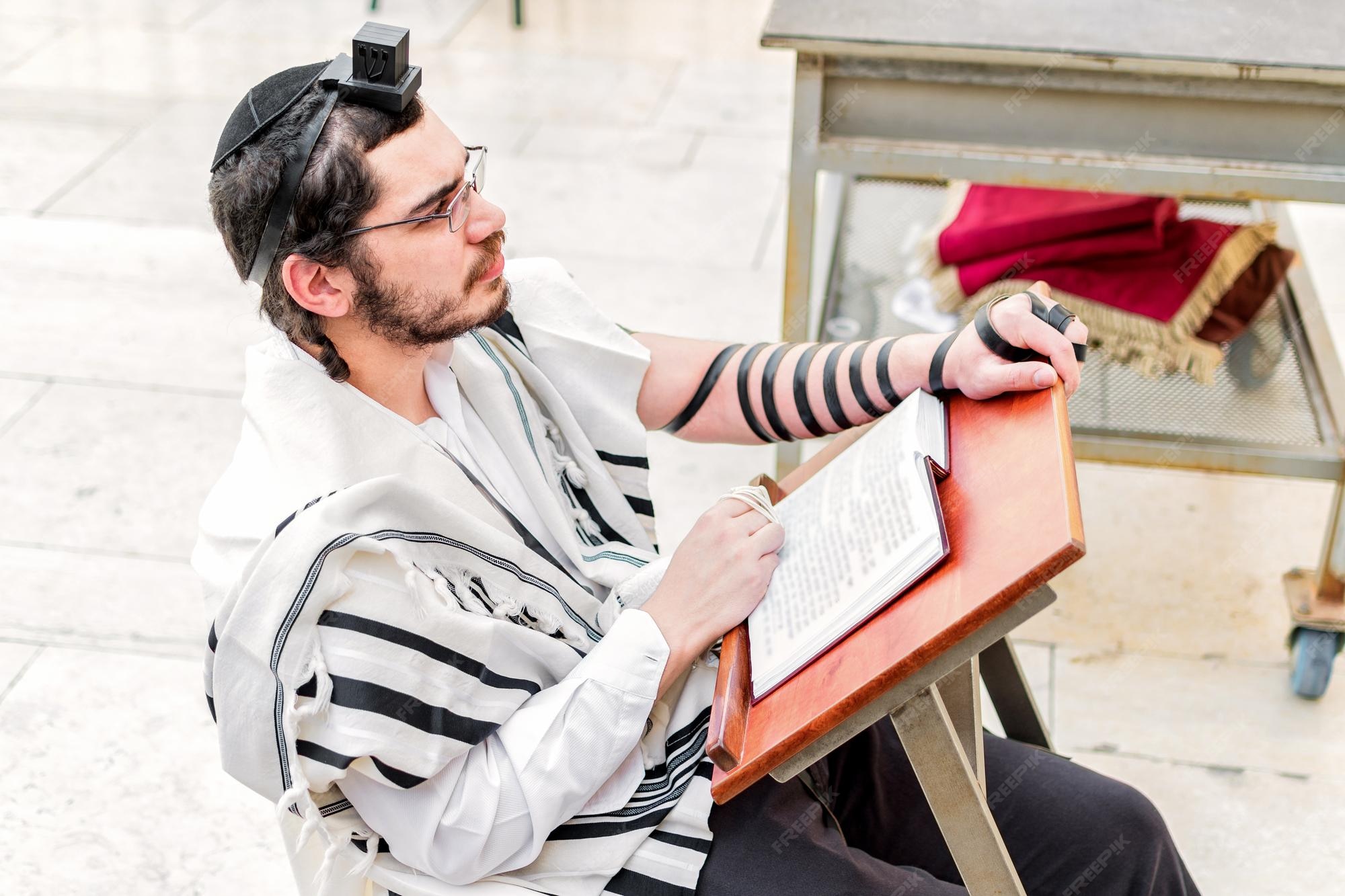
Remember: Not only should children remember (v.7) but adults also, posting visible aids on their head and arm (v.8) in what became known as phylacteries (see left arm and forehead in photo) and doorposts so as to be visible reminders at home (v.9). Remembering is critical especially when all is well (v.10f).
Vigilance and Diligence: Do not let blessing be an excuse for complacency (v.12). Know that distraction by other 'gods' (v.14) will lead to death (v.15). Do not put God to the test (v.16). Faithfulness precedes blessing and success (v.17-19).
Why? When your child asks about the meaning of the Shema or covenant (v.20), tell the full story of slavery (v.21) and redemption (v.22f). This is no small matter. It is your righteousness (v.25) and very survival (v.24.)
It is impossible to overstate the importance of our God and His grace and salvation. It is entirely possible to neglect or diminish His glory or our salvation.
Personal Response: I will be vigilant and diligent daily to remember, seek and obey the Lord and to urge the same on our children and community. No big names or attractions can replace or add to this central personal and primary call.
My Prayer: Father, may the chapter quoted by Jesus in his wilderness temptation be my foundation also.
Deuteronomy 7
No Dilution (v.1-5): If there was no voluntary departure, the seven nations (v.1) occupying the promised land were to be driven out or destroyed (v.1-2). Neither God's holiness or the land He promised Israel was to shared or diluted. Obviously there was to be no intermarriage (v.3f), nor was any vestige of their idols to be retained (v.5), not even the gold or silver covering them (v.25) could be kept. Asherim poles were images of Asherah, the imagined mother of 70 gods including Baal. They were to be burned along with all wooden idols.
God's Sovereign Choice (v.6-8): Abraham was childless when he was chosen, Jacob's family included only 70 people. God did not choose Israel because of their size (v.7) but because of His love and oath to Abraham, Issac and Jacob (v.8) He choose them to be utterly holy and separate to Himself (v.6) from among all the peoples of the earth.
God's Unique Love (v.9-15): God is a faithful, covenant-keeping God to 1000 generations who experience His lovingkindness (v.9), but will repay those who reject Him to their face (v.10). If you are likewise faithful (v.11) as He is faithful (v.12), His blessings will overflow you, your family, farms and flocks (v.13). There will be no barrenness (v.14) or illness (v.15), including those known in Egypt (e.g. ophthalmia, dysentery, smallpox, elephantiasis).
Don't be Afraid, Polluted or Stop (v.16-25): Entirely remove those who occupy the land, do not compromise with them or their 'gods' (v.16), anymore than God compromised with Egypt or it's 'gods' (v.17-19). They will flee as before hornets (v.20). Destroy them as you meet them, step by step, until you have possessed the whole land (v.22-23) and their names are no longer remembered (v.24).
Particularly retain no vestige of their demon-gods (v.25-26) [the sin of Achan, Josh 7:1]. Holding to the Lord is survival (6:24), the cost of pollution is death.
Personal Response: Though no one believe the cost of pollution and compromise, I will hold the Lord, faithful to His love and know the blessings of His faithful love.
My Prayer: Father, I joyfully walk in faithfulness with You, in peace and trust, siding with You whatever the world may ask or demand, loving and enjoying You forever!
Deuteronomy 8
Wilderness: Israel had much to learn about their covenant relationship with the Lord. They had seen God's power and provision in the Exodus and journey to the promised land but didn't yet trust Him. For this reason the Lord humbled them when they refused to enter the promised land. In the wilderness then He also tested them to see what was in their hearts, whether they were ready to walk in obedience with Him (v.2-3). God both provided for them (v.3-4) and disciplined them (v.5) to prepare them to walk in His ways (v.6) and receive His good gifts (v.7-9).
Goodness: The land before them was full of good soil and water (v.7), crops of every kind (v.8), even iron and copper for tools and weapons (v.9). There is no scarcity in the Lord's goodness.
The Scourge of Loss of Historical Memory: When you are comfortable and satisfied, remember to bless the Lord who gave it (v.10). If you forget the Lord, deny or ignore the history His has given (v.11-13) and proudly place yourself in the centre (v.14), overlooking His redemption (v.14), protection and provision (v.15) and the lessons of His discipline and testing in the wilderness (v.16), you will perish. If you spurn the God of your history, enthroning yourself (v.17) in His place, you will perish (v.19-20) along with the other nations who reject Him.
The heart of the matter is this: Deut 8:19: If you forget (the LORD your God and go after other gods and serve them and worship them, I solemnly warn you today that) you will surely perish.
History as Battleground: The Lord is in, works through and is over our history. Not all have the eyes to see Him or hearts to acknowledge Him in history, but those who do, are blessed. Christians are not alone in arguing from history. This may be why history is a secular battleground, with revisionism common to shape identity and ideology.
Acknowledging the Source of Wealth: Many wealthy people do not serve the Lord with their wealth. Yet it is God gives the ability to make wealth (v.17-18). The contrast is not between the individual and the state having the means of production but between man and God being the source of blessing.
Personal Response: I will remember the Lord's goodness with joy, walk with Him and in His ways, now and every day, enjoying His presence and blessings.
My Prayer: Father, I confess the fallen human heart can long remember wrongs against it but will soon forget your undeserved goodness to us. Give me a long memory of your goodness, grace and forgiveness. Give me the ability to remember history and to urge true history on our children's children also.
Deuteronomy 9
Fear Not the Giants: It is the Lord who crosses the Jordan ahead of you. It is He who overcomes the giant sons of Anak (v.3). It is not you. It is not your righteousness (v.4-6). It is the Lord. It is because of His faithfulness to His promise to Abraham, Isaac and Jacob (v.5). It is because of the wickedness of Anak God is punishing them (v.4-5).
Take no pride in your righteousness: The Lord is going before you to give victory despite your stubbornness (v.6). Indeed, you were rebellious from the day you left Egypt to today (v.7). Remember Israel made a calf image even while Moses was on Mt. Horeb with God (v.8) receiving His covenant with them. God was so angry He wanted to destroy and replace Israel with the descendants of Moses. (v.14).
Moses Intercession: In response, Moses lay prostrate before the Lord for 40 days asking God to spare them (v.18). Moses destroyed the calf image, ground it up and threw it into the stream flowing down the mountain (v.21). Later, when Israel refused to enter the promised land, God was angry at their rebellion (v.22-24) and wanted to kill them. Moses again lay prostrate for 40 days asking the Lord to spare Israel (v.25). Moses asked God to overlook their stubbornness lest the surrounding peoples misunderstand the reason for Israel's death (v.28). Moses reminded God that Israel, despite their rebellion, were the people of His promise and inheritance; those He saved for His glory (v.29).
God works for us and through us despite our weakness, sin and willfulness. Glory to Him alone!
Personal Response: I will cross the Jordan, fight the giants, confident of the Lord's victory, not because of my righteousness but His goodness and glory.
My Prayer: Father, go before me today, drive out the giants before me, not because of my strength, wisdom or goodness but because of Your great grace and mercy and generosity to me. Glory be to you alone!
Deuteronomy 10
God's persistence: After Israel turned from Yahweh their deliverer to worship Egypt's god (bull calf of gold) God called Moses back up the mountain to renew the covenant. Moses stayed 40 days and nights (v.10). He was directed to cut new tablets of stone to replace the ones he smashed (v.1) and a wooden ark (chest or strongbox) in which to keep them (v.1-3). Moses cut the stone tablets, God wrote on them (v.2). This highlights the divine/human partnership; each has a part but the words are the words of God.
Our response: "Fear, love, serve, keep" (v.12-13) are the key attitudes and actions of faithful response to the God who owns the highest heavens and deepest seas (v.14), yet set His love on us (v.15). Therefore we soften our hearts (v.16).
God's character: is magnificently stated here (v.17-18), the root and source of our ethic serving the weak (v.19). "Fear, serve, cling, swear, praise" are further attitudes and actions by which we respond to great and awesome God who saves (v.21) and prospers (v.22) us. Verses.12-13 are the strong foundation of abbreviated summary of Micah 6:8 which often eclipses the richer original expression here.
Our relationship with God is always our response to that which He initiates. Our ethic likewise is always our response to His awesome character.
"For the LORD your God is God of gods and Lord of lords, the great, the mighty, and the awesome God, who is not partial and takes no bribe. He executes justice for the fatherless and the widow, and loves the sojourner, giving him food and clothing. Love the sojourner, therefore, for you were sojourners in the land of Egypt." (Deut 10:17-19)
Personal response: I will "fear, love, serve, keep to, cling to, swear by, and praise the Lord" (v.12,13,20,21) for He alone is worthy!
My Prayer: Father, thank you for your persistence, holiness, unspeakably magnificent and awesome character, worthy of eternal praise!
Deuteronomy 11
Historical Memory: Remembering is vital to our identity and foundational relationships. Moses is not reminding those who have not seen the greatness of God (v.2), His deliverance from generational slavery (v.3), victory over Egypt's army poised against unarmed refugees (v.4), provision in the barren wilderness (v.5) and discipline of wilful rebellion (v.6). No, Moses is rather reminding a generation (who were 10 years old at the Exodus, now in their 50's), who have seen all this and must remember this in the challenges ahead (v.7).
Applying Lessons of History: Just as a child holds his father's hand crossing a stream, Israel is to hold her Father's hand as she crosses the Jordan, then faces nations stronger than she (v.8).
The Good Land: The land of promise, a land flowing with milk and honey (v.9), which will not be irrigated by channels of water directed by foot as in Egypt (v.10) but by rain from heaven (v.11), a land cared and provided for by God (v.12-15).
Stay the Course: Afterwards too, when the land is yours, love and serve the Lord with all your heart (v.13), do not turn away (v.16) but continue to impress God's word on your hearts (v.18), teach them to your children (v.19) and keep them before your eyes (v.20). As, and only if you do, will the land be fruitful (v.17), will your family and days be extended (v.21) and will the land remain yours (v.23-25).
The Choice: The covenant is conditional. God's love is unconditional but the covenant's blessings are conditional. The choice is between these blessings flowing from walking with the Lord (v.27) and the curse which comes from walking with other gods, who are not gods (v.28). Hold the choice before you visually as you see the mountains on each side of Shechem: Mt. Gerizim representing blessing and Mt. Ebal representing the curses flowing from every false pretender god (v.29-30).
Nothing is more important than walking with the Lord. Every blessing and grace flows from relationship with Him. None of our labour, effort, warfare or technology can come close to having such blessing.
Personal Response: I will walk with the Lord and listen for His voice also in wakeful times of the night. I will ask Him questions when uncertain as to His will or what should be my priorities for the day.
My Prayer: Father, warm and fill my heart anew. Whenever my heart cools, is distracted or looses ardour or focus, speak a gentle word of invitation and call.
Deuteronomy 12
Not the Way of Pagan Nations: The worship of pagan gods is to be eliminated. Israel is not to worship in the places the pagans worship, not on the high places or under leafy trees (v.2.). Nor is Israel to use the means of pagan worship. Pagan altars are to be smashed, their phallic symbols and Asherah poles destroyed (v.3). Israel must worship differently (v.4) because they worship a different God; the only true and living God.
The Way of the Lord Yahweh: Rather then the way of the pagans, Israel is to worship at the location the Lord will reveal (v.5) and bring offerings and sacrifices there (v.6-7). The location will be revealed after Israel has crossed the Jordan and subdued her enemies (v.10) and only there is the Lord to be worshipped (v.13-14). The meat of the offering may be eaten (v.15) but not the life blood in the meat (v.16). All your offerings you may eat in the location of the Lord's choosing (v.17). When you eat, share freely with those with you, strangers, servants and others in need (v.18-19). As the Lord enlarges Israel's territory and the travel distance to the central place of worship becomes great, Israel may also eat of her offerings at home, as long a the life-blood is avoided (v.20-27).
Do not mix the two: Do not be curious about pagan gods and how they were worshiped (v.30). Do not serve the gods Yahweh hates (v.31). Do not burn your sons and daughters as the pagans do (v.31). Do not add to Yahweh's commands or neglect any of them (v.32). There is only One True and Living God who created and redeemed us.
Personal Response: I will not be distracted from the Lord or be allured by the false prince of this world.
My Prayer: Father, the choice could not be simpler or more clear. How can the world repeatedly miss it? I am yours alone.
Deuteronomy 13
Theocracy: A theocracy is a nation agreeing to serve one God only and no other. Israel, on the threshold of entering the promised land, was a theocracy. Individuals were free to leave Israel but not to bring other gods into the nation Yahweh had formed. The principle remains true in the church. Those bringing other gods into the church are to be put out of the church.
Purge evil: Choosing other gods over the One True Living God (I AM) is not mere subjective diversity of expression, variety or choice but is objective evil because only Yahweh is good and God. Therefore, prophets or dreamers (v.1), even if they are your close relatives or friends (v.6), who propose idolatry, are to be removed from the community, even at the cost of their lives (v.5,10). Those who lead others to sin are in greatest danger (Luke 17:1). If the infection spreads to an entire town (v.12-14), the entire town is to be destroyed (v.15-17) so as not to spread further damage. God places first priority on undivided loyalty to Himself (Ryrie)
Personal Response: I will be vigilant of those who lead the Lord's people astray and challenge them directly to depart.
My Prayer: Father, purify your people of all but love and loyalty to you.
Deuteronomy 14
Godly Mourning for the Dead: The Canaanites opened gashes on their bodies to honour the dead. Whether this was an expression of hopeless sorrow or worship of those they believed to have become divine is unknown (v.1). Either however are grievous error, inconsistent with being the people of God (v.2).
Food laws: The reasons specific animals are commended for food, or denied, is not in each case stated, but it is to be noted commended foods are healthy and unclean foods, such as birds that eat carrion (v.12-13) carry risk of illness. Other food laws, such as "do not cook a young goat in it's mother's milk" (v.21), distinguish Israel from the practices rooted in the worldview of surrounding pagan nations.
Purpose of the Tithe: A tenth of all that is produced by flock and field (v.22) is to honour the Lord through sacrifice at the tabernacle (and/or consumed there (v.23). If distance prevents the tithe being transported in kind, the tithe could be converted to money and given or spent (v.24-25) to enjoy with your household and share with Levites (v.27) orphans, widows, strangers and the poor among you (v.29).
Our tithe of God's goodness and provision is both to honour the Lord with sacrifice and to support and serve the poor in our community and beyond.
Personal Response: I will give joyfully to the Lord and to those in need, both my tithes and free-will offerings. I will review my planned and actual giving monthly.
My Prayer: Father, thank you that you receive our gifts of thanksgiving and allow us to enjoy them with those to whom we give them. Help us do both more regularly, deliberately and joyfully.
Deuteronomy 15
God's Solution for Poverty: With the exception of outsiders engaging in business (v.3), members of the community are to be forgiven their debt each 7th year (v.1). True, slow learners may repeat their error (v. 11) and return to poverty but the opportunity to break free is a magnificent unparalleled opportunity. In addition, the loan is limited by need, rather than want (v.8).
If you have Goods, Guard your Heart: Those with poor relatives must not harden their hearts against their poor brother (v.7). To turn them away empty is sin (v.9). Rather lend freely and generously from the heart (v.10-11).
Kinsmen Purchased Servants: It is remarkable that men and women were still bought and sold after Israel's experience of Egypt (v.15). Yet slavery seems to have been deeply embedded in all cultures of the time. In this context, the same principle as the forgiving of loans apply (v.12-13) and the application would be no less startling and life-giving.
Not only is the slave to be set free but supplied generously with food, livestock and wine (v.14). These gifts are a form of deferred payment, roughly equivalent of half the wage of a hired man for whom food and housing would not have been supplied (v.18). If the servant, after 6 years, chooses to stay, working with food, accommodation and clothing supplied, he or she may make the arrangement permanent (v.17).
First born tithe: The first born of every flock and herd is an offering to the Lord, to be eaten, except for the blood (v.23), by the extended household (v.20,22) in a posture of feasting and generosity.
The result is a society composed predominantly of middle class people (v.4) and comparatively prosperous overall: "The LORD your God will bless you, as he promised you, and you shall lend to many nations, but you shall not borrow, and you shall rule over many nations, but they shall not rule over you" (Deu 15:6).
Personal Response: I will lend to family with generous heart, grateful for what is paid back but without exacting a return.
My Prayer: Father, how amazing are your economic principles, how they provide for the poor and test the heart of the well-to-do. Thank you for the Amish and other communal societies drawing from these Biblical principles. Draw more believers into such economic covenants.
Deuteronomy 16
Three Annual Feasts: Israel is to gather 3 times a year in the place God chooses (v.16). On each occasion no man is to come empty handed, but to give in the principle of "not equal amount but equal proportion" according to God's blessing (v.17). The feasts have been celebrated since the Exodus.
Passover / Unleavened Bread: is celebrated, as an anniversary, in the month God delivered Israel from slavery in Egypt (v.1). Israel is to eat unleavened bread for six days, as a symbol of affliction and the removal of sin (v.3-4). Leaven symbolizes the permeating sin to be removed by the sacrifice of the lamb. The seventh day is a communal celebration and rest, without work.
Weeks / Pentecost: Seven weeks afterwards is an opportunity for free-will offering in proportion to the Lord's blessing to be shared with family, servants, neighbours, the poor and strangers in the community (v.11). Generosity of goods and spirit is to characterize the celebration of freedom and provision in God's gift of the Exodus (v.12).
Booths: this thanksgiving celebration takes place one week after completion of the harvest (v.13). It is again to be shared with all the community in gratitude to the Lord for His blessing (v.14-15). "Every man shall give as he is able, according to the blessing of the LORD your God that he has given you" (v.17).
Impartial Rule of Law: The phrase "rule of law," so widely valued by those seeking better than despotism, is not used in these verses but is clearly in view. Judges are not to rule by whim or bribe (v.19) but by "righteous judgement" (v.18) based on the laws given Moses by Yahweh. "Justice and only justice" (v.20, NASB) is the standard. It is important to remember the Hebrew term for "justice" and "righteousness" is the same word reflecting God's desire for "right relationship" among all in Yahweh's covenant community.
No Syncretism: Pagan symbols are not to be mixed with worship of Yahweh who is the only King of the Universe. No pagan phallic or fertility symbols are to be allowed near the altar of the Lord your God (v.21). God's chosen people and their governance and worship of Yahweh is to be unique among the peoples of the earth.
Human syncretism is a constant danger diluting the redemptive focus of God's people and His blessing on and through them. "Purity of heart is to will one thing." - Søren Kierkegaard.
Personal Response: I will submit my heart to the Lord to examine for purity of love and relationship, and adherence to His divine redemptive purposes on the earth, on a daily basis in my "quiet time" with Him.
My Prayer: Father, where I risk loss of perspective, clarity, focus, or distraction or deception, prompt me quickly and simply so I do not take one more step on a path that is not directly aligned with You, your purpose and your glory.
Deuteronomy 17
Courts and Judgements: If a court hears the case against someone accused of worshiping the sun, moon or other false gods (v.3), the court may make no superficial judgement but must investigate thoroughly (v.4) and make no judgement without evidence including 2 or 3 eye witnesses (v.6-7). The witnesses must be certain enough of their testimony that they are willing to put their own hands to the execution (v.5). If a local court is uncertain of guilt (v.8), it is to advance the case to priests and judges serving at the central place of worship (v. 9). Their decision will be binding (v.10-12).
Character of a King: Moses seems to accept the likelihood that Israel, when established in the promised land, will want to have a king (v.14). Israel's king however must be of high character, not like the kings of other nations. Israel's king must be chosen by God (v.15), an Israelite (v.15), not look to Egypt for anything (v.16), and is to be distinguished from other potentates by living a modest lifestyle without multiple wives or undue wealth (v.17). To remind himself to God's covenant, the king is to personally handwrite the entire law (Deuteronomy or possibly the whole Pentateuch, v.19) and read it to himself daily so as live by it and not put himself above his countrymen (v.20).
Moses calls for the highest standards of character in leaders who will succeed him and implement God's rule, not a rule of whim or personal gain but of objective unchanging moral law.
Personal Response: I will not be ruled by emotion, anxiety. polls or personal preferences but by God's Word expressed in His character, Christ and the Scriptures.
My Prayer: FFather, I confess I dislike capital punishment so ask it only be applied justly when guilt is without doubt or error.
Deuteronomy 18
The Levites: Just as educational infrastructure support the value of learning, the infrastructure supporting core beliefs are religious. Levites were responsible for this infrastructure of feasts, sacrifices and the tabernacle (v.3). Levites were reminded of their high calling in two ways: 1.) being "wholly owned" by Yahweh who alone was their inheritance, they owned no land (v.2). 2.) In lieu of land, they were sustained by God through the first fruits and sacrifices of His people (v.4).
Levites did own their homes (in the 48 cities of Num 35:2-5) and could pass down property to their descendants (v.8) but remained without land as means of production or generating wealth (v.2). This limitation was a symbol of their dependence on God and His people.
False/Evil Spirituality: False spirituality also has it's beliefs, practices and infrastructure including child sacrifice, witchcraft, sorcery, mediums, divination, spiritism and the casting of spells (v.10-11). Those who practice these things are to be rejected and driven out of the land (v.12). To follow such evil practices is death to those who do so.
True Prophet Like Moses: Though the people of Israel had asked not to hear the voice of the Lord at Mount Horeb (v.16), God assured them He would send another like Moses to speak the Word of God without compromise (v.18). Moses was in this sense a type of Christ. Yet Jesus was greater than Moses. Jesus is the Word of God incarnate.
False Prophets: Prophets are publicly revealed to be false when the event they prophesy does not take place (v.22). When a false prophet speaks in the name of one who is only a pretender to divinity, that spokesperson must not to be feared (v.22) but is, in this theocracy, to die (v.20). Falsehood must to be rooted out because falsehood leads to death, in this life and the next.
True prophets are needed to keep God's people focused on the God who is true and leads to life.
Personal Response: I will be passionate for the truth of God and walk in the way of eternal life.
My Prayer: Father, keep my heart pure and passionate to live the truth you've revealed in Christ Jesus.
Deuteronomy 19
Cities of Refuge: Moses arranged for 3 cities of refuge (v.7) to which one who had accidentally killed another (v.5 "manslayer vs. "murderer") could flee.
The difference between murder and manslaughter is hate (v.4, 11). Neglect, carelessness and accident has consequences also for the person causing harm, not simply covered by a casual "I didn't mean it." Flight to a city of refuge however would save his life. A person hating his neighbour however, causing his death, then fleeing to a city of refuge should not count on its protection. The elders of the city would hear the case, and if guilty, turn the murderer over to be executed (v.12).
Moses anticipated the need for 3 more cities of refuge when Israel took more territory (v.7, 9), The full scope of territory promised to Abraham was subdued under David but not occupied; the 3 additional cities never added.
Land theft: Land was to remain in the family so one family would not grow poorer while the other grew richer. The next generation must receive it's full inheritance (v.14).
Witnesses with power and responsibility: Because the life of another was in the witness's hand, witnesses carried great responsibility. The "eye for an eye" principle of justice did not apply in all relationships (as excuse for revenge) but only to perjury (v.19-21). A single witness alone did not carry this responsibility as a single testimony was inadequate for judgement. "Lex talionis" applied to collusion between 2 or more false witnesses.
Mosaic law was simple, practical, wise. Our complex, elaborate and expensive judicial system - ruling on technicalities with advantage to cunning lawyers available only to the rich - is arguably no better.
Personal Response: I will pursue the promises of God, not as entitled gifts passively dropped into my lap but as wages promised for faithful effort, as outcomes of grace at the end of faithful endurance.
My Prayer: Thank you Father that Jesus is my
city of refuge. Thank you for the cross of Christ. Thank you that even my
high-handed deliberate sin yields to your mercy triumphing over justice. Glory,
glory, thank you, Lord!
Deuteronomy 20
But for the Lord: Victory is not a matter of numbers (v.1) but of the Lord's favour, presence and power as God demonstrated in the Exodus. It is the priests (not generals) who call the army to courage (v. 3) reminding them that Yahweh a) goes with them, b) is against their enemies, c) fights for them, d) and will bring salvation (v. 4).
It's not up to us: The Lord will bring victory without reliance on every available warrior. Those preoccupied by building a house, putting in a vineyard or planning a wedding are free to stay home (v.5-7). Especially those whose faintheartedness would discourage their brothers should say home (v.8). Gideon drew heavily on this principle preparing against the Midianites (Judges 7).
Overcoming Canaan: The six peoples occupying Canaan (v.17) were to be utterly destroyed. This was both to punish Canaan for their great evils (Deut 9:4-5) and to protect Israel from their detestable influence (v.18).
Beyond Canaan: Outside of Canaan cities were to be offered terms of peace (v.10). If they accepted, the occupants would serve the Israelites (v.11). If they refused, the city would be besieged (v.12), it's men killed (v.13) and all that remained taken as booty (v.14).
God's fierce holiness shaped Israel's mission. Yahweh opposed unholy peoples but sanctified His chosen people to be holy in all they did. (God focused Israel on His holiness through the tabernacle, sacrificial system, Israel's clean/unclean practices and personal moral standards which set Israel apart from their neighbours.
Personal Response: I will not even look at the evil practices of those around me, so as not to be polluted by them. I will not be afraid, but confident in the Lord, rather than in my strength or abilities.
My Prayer: Father, keep my eyes and heart on you. You alone are holy, true, pure and beautiful. I want to be like you - wholly sanctified.
Deuteronomy 21
All Sin Requires Atonement: Even when someone "gets away with murder" (v.1), atonement must be made for the sin. Since the murderer does not initiate the request, the leaders of the nearest city (v.2-3) are to take that responsibility, sacrificing a heifer (v.4) to represent perhaps both the requirement of capital punishment and need for substitutionary atonement, in this case by designated proxy, and washing their hands (v.6) to show they have done their duty. The community is now free of guilt.
Wife from Among War Captives: The provision applied only to wars outside Canaan (20:15). A time of grieving the loss of her family preceded a forced marriage (v.13) and divorce remained a possibility, but not selling (v.14). Since these provisions were not considered mistreatment (v.14) one can only imagine the practices of other nations of the era.
Rights of the First Born: If a man has more than one wife, the son born first is to receive a double portion of this father's inheritance (v.17), even if his father loves the mother of the second born son more (v.15-16).
An Evil Son: If a son is stubborn and rebellious and does not respond to love or discipline, his parents can submit him to the judgement of the elders of the city (v.20) up to and including death (v.22). While there is no record of an application of this parental right, it's inclusion in the law would certainly have deterrent effect.
The law cannot make people good but has some restraining effect on our evil tendencies. The law also places absolute limits on the expansion of evil.
Personal Application: I will apply the boundaries of law only where even the glorious gift of love is spurned.
My Prayer: Father in a world in which both Law and Gospel have their relative effects on human hearts, may I not be weighed down by squinting at provisions of the law but be lifted by love and be one who so lifts those around me.
Deuteronomy 22
Your Neighbour's Goods: Loving your neighbour as your self means caring for your neighbour's livestock or goods (v.1-4) as you would your own. If you don't know who goods belong to, care for them as you care for your own until it is clear to whom the goods belong, then return them.
Distinction between the Sexes: The distinction between sexes extends to clothing.
Protecting Others: Wildlife may be taken for food, except the mothers who must be protected so that wildlife generations are extended as we would want our own generations to be prolonged (v.6-7). Guests to our homes must also be protected as by providing a wall around a flat roof as warning against the danger of falling (v.8).
Avoiding Mixtures: in farming, plant just one kind of grain or grape at a time (v.9). Put two oxen or two donkeys in a yoke, rather than one of each (v.10). In weaving, make a garment of just one kind of material (v.13). The reason for the prohibitions vary from principles of agriculture to kindness to animals to separating Israel from the superstitious believes of the pagans, but the very principles of simplicity and orderliness also seem to align with God's character and purposes for His people.
Virginity before marriage: A man has a right to expect his wife to be a virgin (v.13-14), as would the reverse be true. The means of determining virginity may not be as clearly spelled out as some may wish (v.17) but false charges of promiscuity elicit both flogging (v.18) and a fine of 1.1 kg of silver (v.19).
Promiscuity, as is the case with adultery, is a capital offense (v.20-22). This applies to a man and his stepmother (v.30) and the rape of an engaged woman (v.25). If the engaged woman consents to the act, as evidenced by not calling for help, she is treated as an adulterer. Rape of an unengaged woman required the man to pay the bride price, marry her (so she is not further dishonoured by being disqualified from marriage) and never to divorce her (v.28-29).
God's law is put in place to protect the innocent from both neglect and abuse.
Personal Response: I will protect my neighbour from loss, neglect or abuse. I will care for my neighbour in these matters as I care for myself.
My Prayer: Father, help me discern the desires of your heart and character underlying your commandments and to love your heart for these evidences of your holy and compassionate character.
Deuteronomy 23
Citizenship: Citizenship in the tribes of Israel was not open to those holding to pagan religions, such as Ammonites (v.3) or those who emasculated themselves in practicing pagan religion. Nor was it open to Moabites who refused to aid Israel as she left Egypt and hired Balaam to curse her(v.4). Nor were those of illegitimate birth welcome in the assembly (v.2). Israel was to be a holy people. Edomites and Egyptians were welcome but only in their 3rd generation having proved their adherence to the Lord (v.7-8).
A Holy Army: Even on military mission, Israel was to be holy (v.9), being made clean after a nocturnal emission (v.10-11) and providing for camp sanitation (v.12-13). If the Lord were to walk through the camp, he must see nothing indecent (v.14) for the camp and it's army must be holy.
"Because the LORD your God walks in the midst of your camp, to deliver you and to give up your enemies before you, therefore your camp must be holy, so that he may not see anything indecent among you and turn away from you." (v.14)
Separation from unholy peoples: If a slave escaped from a cruel Canaanite master (v.15), he or she should be protected and free to live in the Israelite community (v.16). Israelites are to be morally separate from cult prostitution as practiced by neighbouring peoples, neither female or male (homosexual) prostitution (v.17), nor may money earned by prostitution may be offered to the Lord (v.18).
Interest: interest may be charged to foreigners (v.20) but not to citizens (v.19). Interest free loans to citizens is part of the blessing of being part of God's people.
Voluntary Vows to the Lord: Vows to the Lord are unnecessary (v.22) but if you make a voluntary vow, no delay in fulfillment is permitted (v.21). Therefore be careful of what passes your lips (v.23).
Liberty without Licence: A hungry person may sample from his neighbour's vineyard or grainfield but may carry nothing out (v.24-25). Generous sharing may not be abused or taken advantage of.
Citizenship in the Israel and the Kingdom of God has precious privileges and responsibilities, not to be separated.
Personal Response: I will be holy in large and small matters of the heart, and holy in relationships with those of the world and in the Body of Christ. I will speak promises only with forethought and follow-through.
My Prayer: Holy, Holy, Holy are you Lord God Almighty. May all the earth praise you. May your holiness cover the earth forever. May your holiness cover me as a cloak and may I reflect your glory.
Deuteronomy 24
Divorce and Re-Marriage: A woman twice-divorced cannot remarry her first husband (v.1-4). The implication appears to suggest she is to remain single. When a man marries, he should be free of military and civic responsibility for a full year (v.5).
Kidnapping: the use of violence to kidnap a member of the community must be cleansed by capital punishment (v.7).
Leprosy: must not be spread but eradicated by adherence to the principles of Lev. 13. (v.8-9).
Pledge to Re-pay a Loan: The pledge (collateral) may not be taken without being given (v.10-11), nor may a pledge interfere with the livelihood of the borrower (v.6) or leave the borrower vulnerable to the elements (v.12-13, 17). A debt may not be extracted from a relative, especially when the debt is one's life (v.16).
Care for the Poor: Payment of wages must be made on the same day as the work is done (v.15) so that the worker is not taken advantage of. Special care is due to immigrants and those without intact families (v.17). Grain, olives and grapes at harvest time may not all be taken by the owner but some left for the needy (v.19-21).
Compassion for the needy is rooted in part in remembering what it was like to be abused as slaves in Egypt (v.18,22).
Personal Response: I will be generous with the needy and always carry a separate folder of cash in my wallet to give freely.
My Prayer: Father, thank you for reminding us of your grace in freeing us from slavery to sin and greed that we might have compassion on the oppressed, poor and needy.
Deuteronomy 25
Limited Corporal Punishment: Israel applied restrictions, compared to Egyptian practice, limiting corporal punishment to 40 strokes (v.3), and this in the presence of the judge (v.2) rather than in private where vengeance could be unlimited. Even the convicted criminal is to retain dignity in the community.
Labour rewarded: Whether animal (v.4) or human (1 Cor 9:9-10), labour received may not be taken unrewarded.
The Family Name: Measures to carry on the family name include, in the event of a man's death, the marriage of his wife to the "husband's brother" (levirate, Latin) so that a subsequent first born can be given the first husband's name (v.6). The high value of carrying on "the name" can also be seen in the prescribed public shaming of the man who refuses to responsibility for his brothers family (v.7-10).
The severe punishment (v.12) of the woman who grasps a man's genitals, even in the heat of conflict (v.11), so risking his ability to procreate children carrying the family name, further shows the supreme value attached to a man's "name" beyond his lifetime.
Fair commerce: Clear and consistent standards for weights and measures used in commerce are vital to a just and thriving economy (v.14-15). Honesty honours the Lord's righteous character (v.16).
Eliminating Evil: The Amalekites were among the most savage and inhumane of the Canaanites (Ryrie). Their elimination (v.19) is not to be seen as simple revenge, though it includes punishment (v.18), but is primarily to be seen as something we shrink from today - the removal of evil. In the Biblical worldview, evil does not have an intrinsic right to be, multiply or expand it's reach.
Personal Response: I will pay bills and wages promptly, fairly and generously.
My Prayer: Father, thank you that ethical standards are not a matter of a strongman, the will of the majority or of abstract thought but of your holy and unchanging character. I see Lord how, sometimes in history and sometimes hereafter, you eliminate evil which refuses redemption. I embrace your holiness.
Deuteronomy 26
Thanksgiving: The occasion was the gathering of the first produce of harvest (v.2). Some of it ("the sacred portion" i.e. the part that belonged to God (v.13) was taken to the priest (v.3) who placed it before the altar (v.4).
Remembering: Every family head would then verbally retell Israel's history - from the patriarchs (v.5) to slavery in Egypt (v.6), to deliverance (v.8), to the promised land (v.9). The verbal retelling is vital to maintaining the retained identity of God's people. This remembering also brings gratitude and joy (v.11).
Worship: Gratitude and joy prepares the heart for worship (v.10).
Giving: Thanksgiving is then expressed through giving. The first fruit of the harvest is given to the poor and needy that all may be blessed (v.12-13). "When you have finished paying all the tithe of your produce in the third year, which is the year of tithing, giving it to the Levite, the sojourner, the fatherless, and the widow, so that they may eat within your towns and be filled."
Renewal of the Covenant: Thanksgiving is further the occasion for renewing Israel's covenant with God. The worshiper declares his wholehearted (v.16) commitment to the stipulations of God's covenant (v.13-14) and asks God's blessing (v.15). The covenant commits both parties: the worshiper declares his allegiance (v.17) and consecration to the Lord (v.19) and the Lord declares His love for His treasured people (v.18). As His people are faithful to the covenant God will set them above the surrounding nations (v.19)
Thanksgiving is rooted in a right relationship with the Lord our Redeemer but is not limited to the attitudes of our hearts. Thanksgiving is expressed by the generosity of our hands and goods.
Personal Response: I will enrich the gratitude of my heart by remembering the goodness of God in detail and by giving generously of it to the poor and to the extension of God's Kingdom.
My Prayer: Father, the longer I live the more instances of your goodness I have seen and the more I praise you!
Deuteronomy 27
White Stones: Two large stones were to be set up on Mt Ebal (v.4), whitewashed with lime, on which were to be written the stipulations of the covenant (v.3, 8). Whether this was to be the Ten Commandments or the words spoken by the Levites (v.14-26), both or more, is not here specified.
The Altar: Near these words of the covenant was to be erected an altar of field stones (not cut, v.6) on which peace offerings were made and eaten with joy before the Lord (v.7). The purposeof the covenant is the experience of joy and blessing in relationship with the Lord.
The Ratification Ceremony: was planned by Moses before his death and implemented by Joshua, after crossing the Jordan. This is recorded in Josh.8:30-35.
The Valley of Decision: In the ratification ceremony six tribes would stand on Mt Gerizim, representing the blessings of faithfulness to the covenant (v.12) and six tribes would stand on Mt. Ebal, representing the curses of unfaithfulness to the covenant (v.13). After the blessings were spoken (v.12), the Levites, standing in the valley of decision between them, would speak the curses (v.15-26). The people affirm agreement with an Amen after each declaration.
It is striking that the words outlining the curses exceed the number of words of blessings. It may be that positive consequences are not adequate in themselves to motivate every hard, stubborn, forgetful or sinful heart. It may also be that there are more ways to be evil than there are ways to be righteous.
Personal Response: I will value aids to memory - e.g. scripture memory cards, written "I will" statements, journaling instances of the grace and faithfulness of the Lord - so as not to wander or become half-hearted.
My Prayer: Father, thank you for opportunities for ratification ceremonies, refreshment and renewal of the heart. Help me by these means to overcome distraction and not forget.
Deuteronomy 28
Faithfulness to God's Covenant has Definite Outcomes: There implications are spelled out in 14 verses of blessings (v.1-14) and 53 verses of curses (v.15-68). These profound outcomes should not simply be summarized into a generalized thesis but must be read to experience the emotional impact. Doing so should be adequate to keep us focused for a lifetime.
Yet Israel wandered in much of its history including the Judges, Divided Kingdom and subsequent Siege and Exile, aand experienced most of all these curses in consequence.
Faithfulness to God's Covenant is Faithfulness to God: While much focus is on practical faithfulness to God's covenant, the deepest call is to relationship with God Himself (v.14,20,36,64). The curses are warning to the danger of "other gods" which are not gods but rebellious spirits enticing the unwary to the darkness from which they came. The Old Testament is a call to the blessings of monotheism.
"Do not turn aside from any of the words that I command you today, to the right hand or to the left, to go after other gods to serve them" (v.14). "Other gods" are rebellious dark spirits but include also their lures to pride, materialism, self-worship and their other draws and distractions to turn to the right or the left.
Personal Response: I I wiI will seek the Lord's face and favor above all and ask His discernment to help me avoid distractions, loss of fervor or any second-best.
My Prayer: Father, may I wait and focus on You, looking at You looking at me, and know the deep, eternal, satisfying joy of communion with You. Through all the day, the challenges, dangers and distractions, my eyes are on You and my heart worships You alone.
Deuteronomy 29
Second Covenant: Chapters 29-30 are a ratification of the covenant God made at Horeb (v.1). Some call the a "second covenant" as implied the name given this book, Deuteronomy, but it may be better to see it as Moses' desire to engage the full commitment of the generation born in the desert since Sinai who, despite the wonders they have seen and heard (v.2-3), remain dull of heart (v.4).
Rehearsal of God's Favor: God miraculously extracted Israel from Egypt (v.2), sustained them though great trials (v.3) in the wilderness (v.4), and overcame those who rose up against them (v.7).
Established as His People: Standing now before the Lord (v.10) every person of Israel (v.11,14-15) is called to accept HHis promises and covenant (v.12). This includes emphatically rejecting the false gods of Egypt and all the /span> sssurrounding nations (v.16). Only this way does God is establish Israel as His people (v.13).
The Poison of Wormwood: Moses warns against the pride of a single stubborn heart claiming to have peace while rejecting the Lord (v.19) for the false gods of the nations. A single root can bring the bitter poison (v.18) leading to eternal death (v.20).
Even before the physical death leading from spiritual death, those poisoned by false gods will experience the curses (v.21), the plagues (v.22) and the wasteland portended by Sodom and Gomorrah (v.23). The nations may not understand (v.24) but God's people will recognize the consequence of their abandonment of the God who had been their deliverance (v.25-27), consequences extending to forced exile from the land God had given them (v.28).
None of these consequences are in any sense a secret (v.30) but have been clearly revealed in advance so God's people might be faithful forever.
Moses' Grief: How sad it must have been for Moses to have seen so little spiritual fruit in the hearts of God's people since the Exodus during his 40 years of leadership. This despite the powerful hand of God so evident on Israel (v.5). Now, before his death, Moses urgently seeks a level of commitment from every Israelite to the Lord which he has never seen. Moses has been simple and clear, even blunt. Even so, Moses carries deep concerns about Israel's inability to even grasp the depth of the decision and its implications before them:
"To this day the LORD has not given you a heart to understand or eyes to see or ears to hear" (v.4).
Personal Response: I will be as simple and clear as Moses as I invite people to wholly and only seek and serve the Lord. I will ask the Lord to give each the ability to comprehend the profound and eternity-shifting implications of their response.
My Prayer: Father, give me I pray a heart to
understand your immensity, eyes to see your goodness and ears to hear your call,
to me and to all you love.
Deuteronomy 30
Banishment: Moses foresees, due to the persistent dullness of Israel's heart (29:4), that Israel will be uprooted (29:28) and banished (v.1) (exiled) for idolatry, before returning to the Lord with all their hearts (v.2).
Restoration: When Israel has returned to the Lord wholeheartedly, He will gather them from the nations (v.3) and bring them back (v.4) to prosper them in the land (v.5). The curses Israel brought on themselves will fall on their enemies (v.7) and transformation in Israel will flow from external observance to a radical conversion of heart (v.6). Then the Lord will again rejoice over His people and the produce of their land (v.9).
Accessible by All: God's goodness and blessing is not out of reach (v.11) in heaven (v.12) or across the sea (v.13) but nearby, even in your heart and mouth (v.14). God's covenant is accessible "so that you may observe (live in) it" (repeated four times in vs.11-14); the simple source of covenant blessing.
Two Options (Only): Life and prosperity (v.16, 20) or death and adversity (v17-18) are our only choice (v.15). And the choice is ours (v.19), so choose life!
The mystery of sin is why, though the choice is simple and accessible, and blessings are overwhelmingly to be preferred, sinful man yet repeatedly chooses death and adversity (v.15) over life and blessing.
"I call heaven and earth to witness against you today, that I have set before you life and death, blessing and curse. Therefore choose life, that you and your offspring may live," (v.19)
Personal Response: I will choose life. and choose it repeatedly, countering the dullness of my heart and the temptations, lies and propaganda of the devil and his agents.
My Prayer: Father, may the world hear and Choose Life.
Deuteronomy 31
Faithful Yahweh the Only Constant in Leadership Transition: Moses will not cross the Jordan (v.1) but Yahweh will (v.2), and will be powerful to overcome the peoples of Canaan (v.3) as He did the Amorites (v.4). Be therefore strong and courageous, knowing the Lord will not fail (v.6).
God's Unchanging Covenant was committed to writing (v.9) and deposited in the Ark of the Covenant (v.10, 26). It was to be read publicly in its entirety every seven years (v.10-11) in the hearing of every person, citizen or alien, calling all to live in conformity with God's character and enjoy the benefits of relationship with Him (v.13, 20).
Joshua Commissioned and Warned: Joshua would take Moses' place with the same exhortation and promise (v.7-8, 23). The ceremony took place at the Tent of Meeting (v.14). The Lord appeared in the Pillar of Cloud (v.15) and warned Moses that Israel would forsake Him for the gods of Canaan (v.16), an action to which some proportion of Israel were inclined even before they crossed the Jordan (v.21). As a result Israel would be forsaken by Yahweh (v.17), who would hide His face from them (v.18), giving free-reign to evil among them (v.17).
Moses Final Gift: God told Moses (and Joshua, plural verb) to write a song (v.19) which would not be forgotten (v.21) either in prosperity (v.20) or times of trouble resulting from worshiping the cruel gods of Canaan (v.21). Moses wrote the song that very day (v.22; ch.32).
The Rebellious Heart: The painful consequences of living under Lucifer and his 'gods' in Canaan were known by Moses, Joshua and the Levites (v.25) and elders (v.28) before crossing the Jordan and were to be underscored every seven years. Yet the rebellious heart (v.21, 27)…
Personal Response: I will prepare the next generation well for leadership transition as I step back, specifically now from C2S. I will follow the lead of Moses who had appointed Joshua head of the army (Ex. 17:9), then given more authority (Num 27:18-23), all in preparation for full leadership responsibility to come later.
My Prayer: Father, we know
Satan will continue to afflict, tempt and distract your people
till Jesus returns, so help me prepare those who will
lead after me. Help me
challenge and encourage them, eyes on the goal, pressing in to God's
highest and best.
Deuteronomy 32
The Song of Moses: is a tribute to Yahweh (v.3) given to Moses from heaven itself (v.1). God is perfect, just, faithful and upright (v.2), the only Rock on which Israel and all creation can depend.
Yahweh Throughout History: God divided the peoples at Babel for rebelling against Him (v.8) and chose Jacob from among them (v.9). Yahweh cared for and guarded Jacob and his clan as an eagle protects and prepares her young for the future (v.10-11). It was Yahweh - and no foreign god (v.12) - who provided honey and oil (v.13, flocks, wheat and grapes (v.14). Though fattened by the Lord's generosity, Israel forsook the One who created her (v.15, 18), offending Him (v.16) submitting rather to demons (v.17). Therefore God would spurn Israel (v.18) and provoke nations against them (v.21) as they had provoked Him. God would have rooted them out entirely but would not allow the nations to take to take credit for Israel's demise (v.26-27).
Israel's Foolishness: Because of Israel's foolishness they could not discern their future (v.28) when but a few of their enemies would chase thousands of God's people (v. 30), and this for a simple reason even their enemies understood (v.31). Yet, after Israel's enemies had served their purpose as God's instrument of punishment of unfaithful Israel, Yahweh would punish them too (v.34-35); enemies who had come from spiritually poisonous stock (v.32-33).
God Questions Israel: When Israel's strength is gone (v.36), Yahweh will ask how well the false gods Israel trusted in have served them (v.37-38). They have been of no help.
God is the Only One: This is the theme of the entire OT. God is solely sovereign (v.39), eternal (v.40), just (v.41), the judge of the wicked (v.42) and the Redeemer who atones for His people (v.43).
Word of Life: The words of this Song of Moses are to be taken to heart and lived out (v.46). They are not mere words but "your life" (v.47; Paul may have been thinking of this truth in Col 1:4).
The Finish Line: Moses has run his race and finished his task. Yahweh would call Moses one final time up a mountain (this time Nebo) to meet with Him (v.49). There Moses would die, as Aaron had on Mt Hor, and be reunited with his people (v.50). Moses would look out over Canaan but not enter it (v.52),
The Main Thing: how simple, how essential, how consequential; yet how long and painful the process for Israel to learn and embrace Him.
Personal Response: I will sing daily the hymns and songs that help me remember, just as Moses gave his song to help Israel remember. I will hold fast to the one and only true living God who is my life.
My Prayer: Father, I sing to worship, I sing
to remember, I sing to be lifted above our embattled world, I sing to walk in
hope.
Deuteronomy 33
The Blessing of Moses: As Jacob blessed his sons in Gen 49, Moses blesses them, 400 years later, in Deut 33.
What can we leave with those we love when we leave this earth? Our blessing, which, before it can come from us, comes from Yahweh who loves His people (v.3). God shines from Sinai and lights His people's path to Canaan (v.2).
Reuben, who because of his sin was told "you shall not have pre-eminence" (Gen 49:4) is now blessed to not shrink further "May Reuben live and not die (v.6).
Judah who was promised the sceptre (Gen.49:10) to be "on the neck of your enemies" (Gen.49:7) is again promised God's help against his adversaries (v.7).
Simeon and Levi were rebuked for their fierce anger (Gen 49:7), now Levi is blessed for keeping God's covenant (v.9) and teaching it to his brothers (v.10).
Benjamin was blessed as a warrior (Gen 49:27) and now to know the fruit of victory as the "beloved of the Lord, dwelling in security" (v.12).
Joseph, set apart from his brothers, receives the richest and fullest blessings from Jacob (Gen 49:22-26) and now blessed by Moses with the choice gifts of heaven (v.13) and earth (v.15), resting on his head as a crown (v.16).
Zebulun is promised to be a seafaring people (Gen 49: 13) and is here further blessed in that "going forth" (v.18).
Issachar is affirmed as being strong at labour (Gen 49:14), and now by Moses as bearing fruit from that strength, drawing out abundance from the sea and hidden treasures from the sand (v.19).
Gad was to be raided and a raider (Gen 49:19) and Moses now blesses his strength in this as of a lion (v.20). Gad's strength would also execute Yahweh's justice (v.21).
Dan is seen as a judge among his people and one who ambushes his enemies (Gen 49:16-17), now, presumably in a similar role, as a young lion (v.22).
Naphtali was blessed to be beautiful and fruitful (Gen 49:21) and now further as one full of the Lord's blessing, taking possession of land and sea (v.23).
Asher was blessed with the accoutrements of royalty (Gen 49:20), now expanded to include favor, resources (olive oil, the strength of metals) and leisure (v.24-25).
The God who blesses: God is fully able to bless. He is the one who rides the heavens, coming to your help (v.26) upholding you with His everlasting arm (v.27). God is the one who drives out your enemy, giving you their land (v.27,29). There God will give security, grain and wine and the dew of heaven (v.28). While God will certainly punish those who deliberately and persistently reject Him, His heart and intent is to bless to heights and depths unimaginable.
"Blessed are you, Israel! Who is like you, a people saved by the LORD? He is your shield and helper and your glorious sword. Your enemies will cower before you, and you will tread on their heights.” (v.29)
Personal Application: Only the blessing of the Lord matters. I will seek His face, favour and blessing first and only. I will seek to be a channel of the Lord's blessing to others, in word and deed.
My Prayer: Father, it is the greater who blesses the lesser yet Christ is in me and continues to bless. Give me to hear His words to those around me that I may speak your words of blessing.
Deuteronomy 34
Moses' Death: The last third of Moses' life had taken Israel from slavery to the promised land (v.1-3). Moses, like David, had served God’s purpose in his generation (Acts 13:36). Moses then died (v.5) but unlike David, Moses' body was buried by God Himself (v.6) on Mt Nebo 16 km east of the mouth of the Jordan River.
God's Discipline: Though Moses remained strong in body and retained keen eyesight at 120 years, God did not allow him to enter the Promised Land (v.4). Like others who walked by faith (Hebrews 11:23ff), Moses saw God's promise from afar (Heb 11:39). With this we may often also remain satisfied.
Joshua: had been prepared to take Moses' mantle of leadership by the laying on of Moses' hands. Joshua also received from God Moses' Spirit of wisdom (v.9) but served of necessity primarily as Israel's military, rather than spiritual, leader. Joshua would receive direction from the Lord but through Israel's priests (Num 27:21-23).
Greatest Prophet: By contrast Moses received God's word directly, face to face (v.10). Despite his sin, Moses was Israel's greatest prophet. LaterDavid, despite his sin, was Israel's greatest king. This is not to diminish sin but to delight in God for his grace to bless and work through earthen vessels.
Deut 34:10-11: "there has not arisen a prophet ,,, like Moses, whom the LORD knew face to face, none like him for all the signs and the wonders that the LORD sent him to do..."
Personal Response: I will, despite the sin and insecurities I battle, like Moses, serve God's purposes in my generation as He gives strength until He calls me home.
My Prayer: Father, I thank
you for the model of Moses, faithful and obedient under pressure, leading your
people through extremely difficult circumstances and conditions. Help me look to
you, my rock, as I follow.
 Murray Moerman (